






- This topic is empty.
-
AuthorPosts
-
2026-04-30 at 3:28 pm #15962
In today’s rapidly evolving Industrial Internet of Things (IoT) landscape, connectivity failures pose critical operational risks. Research indicates that 68% of industrial IoT projects experience disruptions due to network instability and hardware malfunctions in extreme environments. As distributed installations proliferate across remote and unattended sites, the demand for customizable industrial 4G routers has become paramount for enterprises seeking reliable, application-specific wireless solutions.
Understanding Industrial 4G Router Customization
Industrial 4G router customization refers to the process of tailoring wireless communication devices to meet specific operational requirements across diverse deployment scenarios. Unlike consumer-grade equipment, customized industrial routers incorporate specialized hardware components, proprietary firmware, and interface configurations designed to withstand harsh environmental conditions while delivering mission-critical connectivity.
The customization spectrum encompasses multiple dimensions: environmental hardening for temperature extremes, interface modifications for legacy equipment integration, protocol adaptations for industry-specific data transmission, and security enhancements for regulatory compliance. This tailored approach addresses the fundamental disconnect between standardized commercial products and the nuanced demands of industrial applications.
Key Customization Dimensions for Industrial Connectivity
Environmental Protection Specifications
Industrial environments present extreme challenges that consumer devices cannot withstand. Customization begins with wide temperature tolerance, enabling operations from -35°C to +75°C—essential for outdoor installations in Arctic telecommunications infrastructure or desert-based solar monitoring systems. Electrostatic discharge (ESD) protection of 15KV prevents equipment failure in high-interference environments such as manufacturing floors and substations.
For outdoor deployments, IP68 waterproof ratings allow direct pole mounting without protective enclosures, reducing installation costs by eliminating the need for additional shelters. The H820QO model exemplifies this approach, featuring built-in 14dBi high-gain antennas that improve signal reception in remote field areas while maintaining weatherproof integrity.
Interface and Connectivity Adaptations
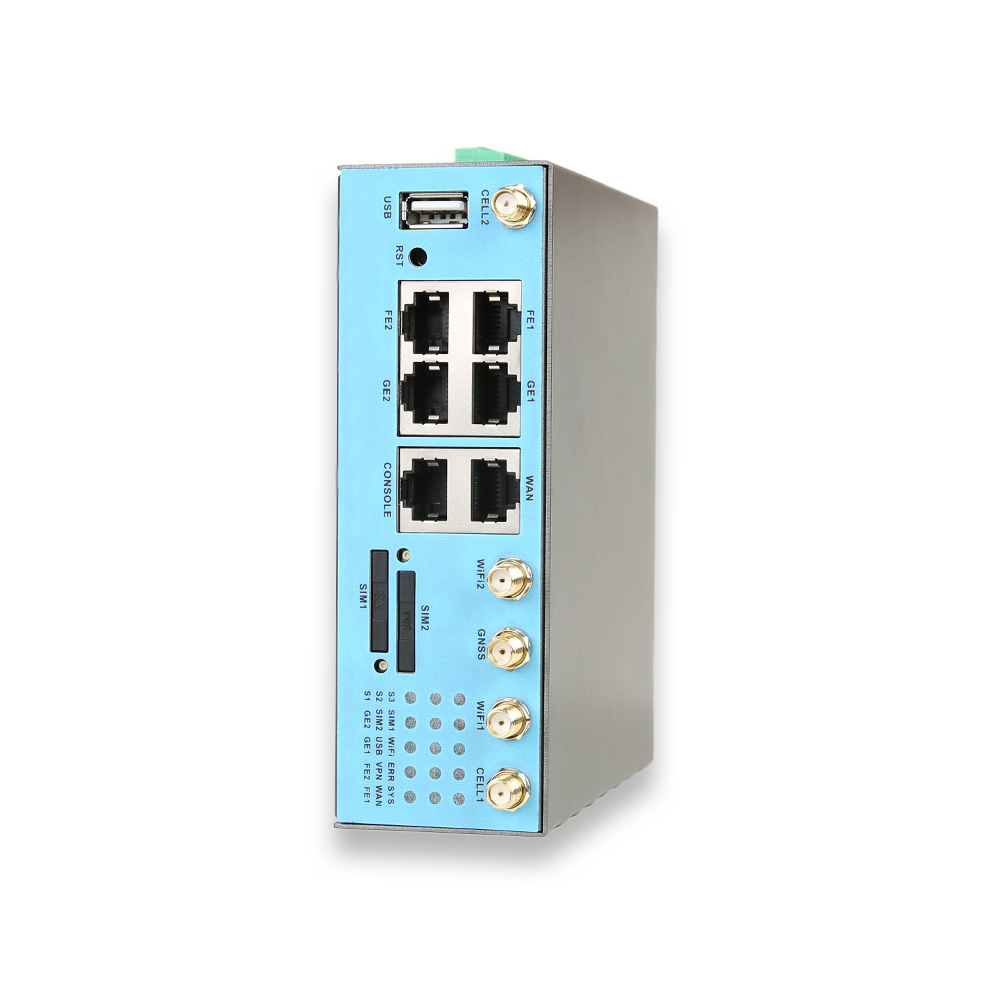
Legacy industrial equipment often relies on serial communication protocols incompatible with modern IP networks. Customizable routers bridge this gap through serial transparent transmission capabilities, converting RS232/RS485 signals to 4G cellular connections. This functionality enables rapid cloud migration for programmable logic controllers (PLCs) and metering systems without requiring equipment replacement.
The compact H685f/H685 series demonstrates space-constrained customization, measuring only 100×60×21mm while integrating Ethernet, serial interfaces, and digital input/output (DI/DO) ports. This ultra-miniaturization addresses installation challenges in automated teller machines, kiosks, and robotic systems where internal space is at a premium.
Network Redundancy and Reliability Engineering
Uninterrupted connectivity forms the cornerstone of industrial operations. Customization strategies incorporate multi-link redundancy architectures combining cellular, wired Ethernet, and WiFi connections. The H900 Gigabit Industrial 4G Router implements triple-link backup with automatic failover switching, achieving equipment online rates exceeding 99.5%.
Dual SIM hot backup functionality provides additional resilience through seamless carrier switching within seconds during network disruptions. This feature proved critical in an Indian telecom operator deployment serving over 230 million subscribers, where the solution achieved a 99.4% equipment online rate across 100,000 units despite unstable power grids and 48°C ambient temperatures.
Security and Protocol Customization
Financial and critical infrastructure applications demand enterprise-grade security beyond standard implementations. Customizable routers support advanced VPN protocols including WireGuard, IPsec, and OpenVPN, providing financial-grade encryption to prevent data interception. An Argentine gaming equipment manufacturer achieved 99.9% data transmission success rates with zero accounting disputes across 25,000 terminals using customized VPN configurations.
Protocol support extends to industrial standards such as Modbus TCP/RTU, SNMP, and TR-069 for centralized network management. These integrations enable seamless communication with supervisory control and data acquisition (SCADA) systems, building management platforms, and utility monitoring networks.
Power Supply and Vehicular Adaptations
Mobile and vehicle-mounted applications require specialized power management. Wide voltage input (5V-55V) with ISO 7637-2 compliance protects against automotive electrical transients, while ignition sensing functionality enables automatic startup/shutdown synchronized with vehicle operation. These features proved essential in a Nordic intelligent transportation deployment, where customized routers reduced network interruption rates to 0.3% during -32°C winter operations across Swedish, Norwegian, and Danish public transit systems.
Power over Ethernet Plus (PoE++) capability represents another critical customization, allowing routers to power connected cameras and sensors through Ethernet cables. This simplifies installation and reduces cabling costs in surveillance and monitoring applications.
Manufacturing and Deployment Customization
Physical form factors significantly impact deployment efficiency. DIN-rail mounting facilitates installation in electrical cabinets and control panels, while wall-mount kits suit building management applications. Desktop configurations with external antennas provide flexibility for temporary installations and testing environments.
For original equipment manufacturers (OEMs), white-label customization enables private branding and firmware modifications aligned with proprietary platform ecosystems. Shenzhen E-Lins Technology Co., Ltd. has leveraged 20 years of independent R&D experience to provide ODM/OEM manufacturing services for global brands including Huawei, ZTE, Samsung, and LG, demonstrating the maturity of customization capabilities in the industrial router sector.
Real-World Customization Impact
A European aviation ground support equipment integrator serving airports in 100+ countries required customized 4G routers for real-time monitoring of aircraft ground power and air conditioning units across electromagnetic-interference-laden airport aprons. The tailored solution achieved equipment online rates exceeding 99.9% while reducing on-site maintenance costs by 68%. Remote fault resolution via 4G/VPN handled 85% of issues without technician dispatch.
These results underscore the tangible business value of customization: not merely technical differentiation, but measurable improvements in operational continuity, maintenance efficiency, and total cost of ownership.
Evaluating Customization Partners
Selecting appropriate customization partners requires assessing multiple capability dimensions. Independent R&D capacity ensures genuine optimization rather than superficial configuration changes—evidenced by 100% self-developed firmware that reduces disconnections compared to generic Linux distributions. Manufacturing scalability supports both prototype development and volume production, with monthly capacities reaching tens of thousands of units.
Global service infrastructure becomes critical for multinational deployments. Providers with established presence across 150+ countries offer localized technical support, reducing mean response times to under 10 minutes during business hours. Lifetime firmware upgrade commitments protect long-term investments as network standards evolve from 4G LTE to 5G NR technologies.
Certification portfolios including CE, FCC, RoHS, and UKCA demonstrate regulatory compliance across major markets, accelerating deployment approvals. ISO 9001 and ISO 14001 certifications validate quality management and environmental responsibility throughout manufacturing processes.
Strategic Customization Considerations
Effective customization begins with comprehensive scenario analysis: documenting temperature ranges, vibration profiles, humidity levels, and electromagnetic environments. Identifying data throughput requirements, latency tolerances, and reliability thresholds establishes performance baselines against which customization options can be evaluated.
Total cost of ownership calculations must account for installation labor savings from integrated mounting solutions, maintenance reduction through remote management capabilities, and extended operational lifespans enabled by industrial-grade components. While customized solutions command premium pricing—typically 20-40% below specialized alternatives through focused product lines and scaled supply chain management—the avoided costs of downtime and maintenance often generate positive returns within 12-18 months.
Future-proofing strategies should consider upgrade pathways as 5G RedCap and full 5G networks expand coverage. Modular designs allowing antenna upgrades, cellular module replacements, and edge computing expansions preserve infrastructure investments while adapting to technological evolution.
Conclusion
Industrial 4G router customization transcends product differentiation to become a strategic enabler of operational excellence in distributed, unattended, and mission-critical environments. By aligning hardware specifications, software capabilities, and physical configurations with specific application demands, customized connectivity solutions transform network infrastructure from a potential failure point into a competitive advantage. As industrial IoT deployments accelerate globally, the organizations that master customization—whether as end users or technology providers—will establish the reliable, secure foundations upon which digital transformation succeeds.
https://e-lins.com/
E-Lins Technology Co., Ltd -
AuthorPosts

- You must be logged in to reply to this topic.