






- This topic is empty.
-
AuthorPosts
-
2026-08-21 at 2:29 pm #17276
In poultry feed production, packaging is often treated as the final step of the process. In reality, it has a direct impact on production efficiency, labor requirements, weighing consistency, storage, transportation, and overall product quality.
A feed mill may have efficient crushing, mixing, pelletizing, and cooling equipment, but if the packaging process still relies heavily on repetitive manual work, packaging can become the bottleneck of the entire production line.
For this reason, more poultry feed manufacturers are considering packaging automation. However, automation does not always mean installing a fully automatic line. For many small and medium-sized feed mills, a semi-automatic packaging machine can be a practical way to improve productivity while keeping the existing production process relatively simple.
For manufacturers handling 20kg, 25kg, or 50kg bags, the right packaging equipment can help create a more stable and manageable packaging workflow.
Why Poultry Feed Packaging Deserves More Attention
Poultry feed is commonly produced in pellet or granular form. After the feed has been processed, it needs to be accurately weighed, filled into bags, sealed, transported, and prepared for storage or shipment.
When these operations are performed manually, several problems can occur.
Operators may need to repeatedly lift empty bags, hold them during filling, check the weight, remove filled bags, and prepare the next package. Over a long production shift, these repetitive tasks can consume considerable labor.
Manual operations can also create variations in working speed and filling consistency.
A packaging machine introduces a more standardized process. Instead of relying entirely on manual judgment, the weighing and filling operations can be controlled according to predefined parameters.
This does not eliminate the need for operators. Instead, it changes their role from performing every repetitive movement to monitoring the equipment, managing bags and materials, checking production quality, and responding to abnormal conditions.
Accurate Weighing Helps Control Feed Costs
Weight consistency is one of the most important considerations in poultry feed packaging.
Whether a manufacturer sells feed in 20kg, 25kg, or 50kg bags, the actual filling weight needs to remain within the required tolerance.
If bags are consistently underfilled, customers may receive less product than expected. If they are consistently overfilled, the manufacturer may lose material and reduce its profit margin.
A suitable packaging machine can integrate the weighing and feeding process to make filling more consistent.
However, manufacturers should remember that weighing accuracy depends on more than the weighing system itself.
Poultry feed can vary in:
-
Bulk density
-
Pellet size
-
Moisture content
-
Particle distribution
-
Flowability
-
Material temperature
These characteristics can affect how quickly the feed enters the bag and how the feeding system performs.
Therefore, the packaging machine should be selected according to the actual characteristics of the feed rather than relying only on nominal machine specifications.
Semi-Automatic Packaging Is a Practical Option for Many Feed Mills
Fully automatic packaging systems can provide a high level of automation, but they may not be necessary for every manufacturer.
A smaller or growing feed mill may already have workers available for bag placement and handling. In this situation, a semi-automatic machine can automate the most repetitive and measurable parts of packaging without requiring a completely new production line.
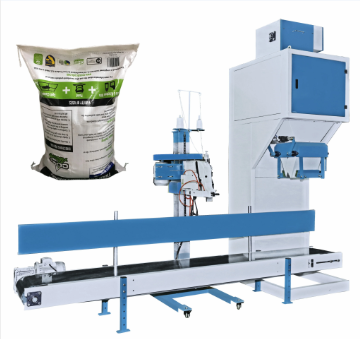
For example, a 20kg, 25kg, or 50kg semi-automatic poultry feed packaging machine can be configured for different feed products and bag sizes according to the production requirements.
The operator may still place the empty bag manually, while the machine handles the weighing and filling process.
This approach can provide a useful balance between automation and operational flexibility.
It can also make future upgrades easier. As production increases, manufacturers can consider adding conveyors, automatic sewing or sealing equipment, palletizers, stretch wrapping systems, or robotic handling equipment.
Reducing Repetitive Labor in Daily Production
One of the main reasons to introduce packaging machinery is to reduce repetitive manual work.
Imagine an operator handling hundreds of bags during a single shift. Each bag requires similar actions: positioning, filling, removing, and preparing for the next cycle.
Although these tasks are relatively simple, repeating them continuously can lead to fatigue and inconsistent working speed.
A semi-automatic packaging system can take over the more repetitive parts of this process.
The operator can focus on:
-
Bag preparation
-
Machine monitoring
-
Weight verification
-
Material supply
-
Quality inspection
-
Troubleshooting
-
Production coordination
This can make the working process more organized and reduce dependence on individual operator experience.
Consistent Filling Improves Bag Handling
The packaging process does not end when feed enters the bag.
Filled bags may subsequently pass through sealing, conveying, stacking, palletizing, wrapping, warehousing, and loading operations.
If bags have significantly different filling weights or inconsistent shapes, downstream handling can become more difficult.
For example, unevenly filled bags may not stack properly. This can create additional manual work during palletizing and transportation.
A stable filling process helps produce more consistent packages, providing a better foundation for downstream automation.
This is particularly important for feed manufacturers that eventually plan to install automatic palletizing or robotic handling systems.
Consider Packaging Flexibility When Choosing Equipment
Many feed mills produce more than poultry feed.
The same facility may manufacture:
-
Poultry feed
-
Cattle feed
-
Fish feed
-
Animal feed pellets
-
Granular fertilizer
-
Other bulk granular materials
If the packaging equipment can accommodate different materials and bag sizes, manufacturers may be able to use the same packaging area for multiple products.
However, flexibility should not be evaluated simply by looking at the number of materials listed in a machine specification.
Different materials can have very different flow characteristics.
Feed manufacturers should consider whether the machine can operate effectively with their actual material density, pellet dimensions, feeding behavior, target weight, and required production rate.
Proper commissioning and parameter adjustment are also important for maintaining stable performance when changing products.
Packaging Automation Can Improve Production Management
Automation provides benefits beyond labor reduction.
A standardized packaging process makes production easier to monitor and manage.
When packaging is performed manually, it can be difficult to determine why production slows down. The problem could be insufficient labor, inconsistent weighing, slow bag handling, material flow, or downstream transportation.
With a machine-based process, each stage can be monitored more clearly.
If an abnormal condition occurs, maintenance personnel can inspect specific components such as the feeding mechanism, weighing system, electrical controls, sensors, or conveying equipment.
This structured approach can simplify troubleshooting and reduce dependence on individual operator experience.
For growing feed manufacturers, standardized processes can become increasingly important as production volumes increase.
How to Choose a Poultry Feed Packaging Machine
There is no single packaging machine that is ideal for every poultry feed manufacturer.
Before making a purchasing decision, it is useful to evaluate the following factors.
1. Bag Weight
Determine whether the factory mainly packages 20kg, 25kg, 50kg, or other bag sizes.
2. Feed Characteristics
Consider pellet size, bulk density, moisture, flowability, and material consistency.
3. Required Production Capacity
The required number of bags per hour should be matched with the actual production capacity of the feed mill.
4. Bag Specifications
Bag material, dimensions, opening design, and sealing method can affect machine configuration.
5. Existing Equipment
The packaging system should work effectively with existing conveyors, storage bins, elevators, mixers, pelletizers, and other production equipment.
6. Available Labor
Determine which operations should remain manual and which repetitive tasks should be automated.
7. Factory Layout
Available installation space, material flow, operator access, and maintenance areas should all be considered.
8. Future Expansion
If production is expected to grow, it may be worthwhile to select equipment that can later be integrated with conveyors, palletizers, wrapping machines, or robotic systems.
Why Practical Automation Is Often Better Than Maximum Automation
A common mistake when planning a packaging system is assuming that the highest level of automation must always be the best solution.
In practice, automation should solve specific production problems.
For a small feed mill, replacing every manual operation may not be economically or operationally necessary. A semi-automatic machine may already provide substantial improvements in weighing consistency, filling efficiency, and labor utilization.
For a larger manufacturer, a fully automatic packaging and palletizing line may be more appropriate.
The right question is therefore not simply "How automated can the packaging line be?"
A better question is:
"Which packaging operations are currently limiting production efficiency, and what level of automation can solve those problems?"
This approach allows manufacturers to invest in equipment based on actual production requirements.
Muniu Machinery's Approach to Feed Packaging
Jiangxi Muniu Machinery focuses on the research, development, manufacturing, and supply of packaging equipment for different industrial applications.
Its equipment portfolio covers open-mouth bag packaging machines, automatic bagging machines, palletizing systems, robotic equipment, stretch wrapping machines, automatic strapping machines, valve bag packaging machines, food packaging equipment, small-bag packaging machines, ton-bag packaging systems, conveyors, lifting equipment, sealing machines, and other packaging equipment.
For poultry and animal feed manufacturers, this type of equipment can be incorporated into different packaging workflows according to production capacity, bag size, material characteristics, and automation requirements.
The focus should be on creating a packaging process that is practical for the factory rather than introducing automation simply for the sake of automation.
Preparing for Future Packaging Automation
A semi-automatic packaging machine can also serve as a step toward a more automated production system.
A manufacturer may initially automate weighing and filling while keeping bag placement and certain handling operations manual.
Later, the factory can add:
Packaging machine → Conveyor → Sealing → Automatic palletizing → Stretch wrapping → Warehouse handling
This staged approach allows manufacturers to increase automation as production requirements develop.
It can be particularly useful for growing feed mills that want to improve efficiency without replacing their entire packaging operation at once.
Conclusion
Poultry feed packaging plays an important role in determining the efficiency of the final stage of feed production.
Accurate weighing, stable filling, reduced repetitive labor, consistent bag handling, and compatibility with downstream equipment can all contribute to a more efficient packaging operation.
For manufacturers packaging 20kg, 25kg, or 50kg poultry feed bags, semi-automatic packaging equipment can provide a practical balance between manual operation and automation. It can improve the consistency of core packaging processes while maintaining operational flexibility.
The most suitable solution depends on the feed material, bag specifications, production capacity, workforce, factory layout, and future automation plans.
Instead of pursuing maximum automation immediately, manufacturers can focus on identifying the specific bottlenecks in their packaging process and selecting equipment that addresses those challenges. This approach can make poultry feed packaging more consistent, manageable, and ready for future production growth.
http://www.muniupack.com
Muniu -
-
AuthorPosts

- You must be logged in to reply to this topic.