






- This topic is empty.
-
AuthorPosts
-
2026-09-18 at 7:50 pm #17645
While Fans watch official practice sessions on the Laver Cup court.
For spectators, professional tennis may look simple: a court, a net, two players and a ball.
For a lighting engineer, however, a professional tennis court is a much more demanding environment.
The lighting system has to help players track a fast-moving ball, maintain visual comfort, provide consistent illumination across the entire court and support high-quality broadcast images—all without creating distracting glare.
So, what should a professional indoor tennis lighting system actually deliver?
1. Tennis Lighting Is About More Than Brightness
One of the most common mistakes when selecting LED tennis court lighting is focusing only on illuminance.
A brighter court is not necessarily a better-lit court.
Tennis is a visually demanding sport because the ball can move rapidly across different directions and heights. Players need to see the ball clearly when it is:
· close to the net
· near the baseline
· high above the playing surface
· moving toward or away from the player
· travelling through the peripheral field of vision
This means that lighting quality depends on several factors working together:
Illuminance + uniformity + glare control + vertical visibility + optical distribution
A professional sport lighting design therefore needs to consider the complete visual environment rather than simply increasing fixture wattage.
2. Uniformity Matters When the Ball Is Moving at High Speed
A tennis court may appear bright when viewed from the stands, but uneven lighting can become obvious to players.
If some areas of the court are significantly brighter or darker than others, the player’s eyes have to continually adapt as the ball moves through different parts of the playing area.
This can affect visual comfort and make fast-moving shots more difficult to track.
For this reason, professional tennis court lighting should provide consistent illumination across the playing surface while also maintaining suitable lighting conditions above the court.
SCL Sports Lighting tennis lighting solution specifically emphasizes both average horizontal illuminance and uniformity, while also considering illumination within the playing volume where the ball travels.
This is one reason why professional lighting design should begin with a photo–metric calculation rather than simply selecting a fixture based on wattage.
3. Glare Can Be More Distracting Than Low Light
For tennis players, glare is particularly problematic.
A fixture may produce enough light on the court while simultaneously creating a bright source in the player’s field of view.
This becomes especially important when players look upward to follow lobs or high-speed shots.
Poorly positioned fixtures can create:
· direct glare
· uncomfortable brightness
· visual distraction
· reflections in the player’s field of view
· reduced contrast between the ball and background
The solution is not simply to reduce the lighting level.
Instead, the fixture’s optical design, mounting height, beam angle and installation position need to work together.
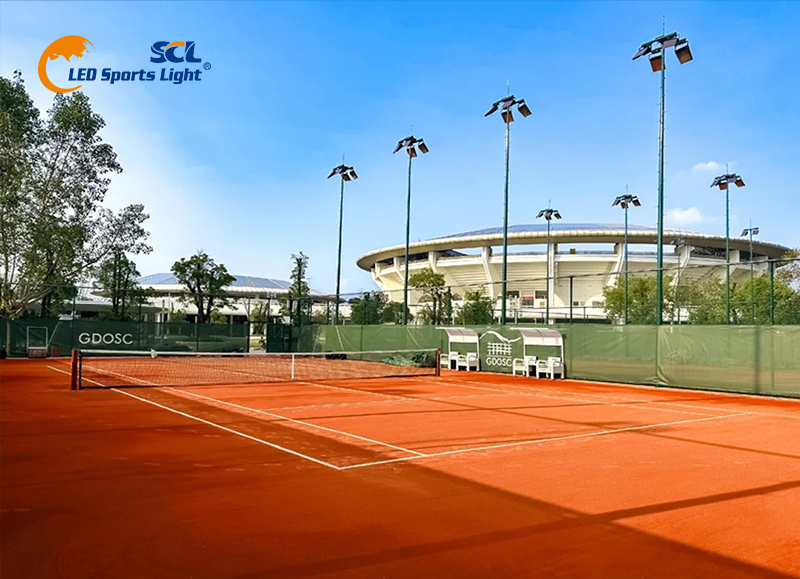
SCL Sport court tennis court lighting guidance recommends carefully considering pole positioning and light projection angles, with anti-glare design playing an important role. It also notes that four- or six-pole arrangements should be designed carefully rather than simply placing poles in the four corners of the court.
4. Indoor Tennis Creates a Different Lighting Challenge
Outdoor tennis courts have natural background light during the daytime. Indoor tennis venues do not have that advantage.
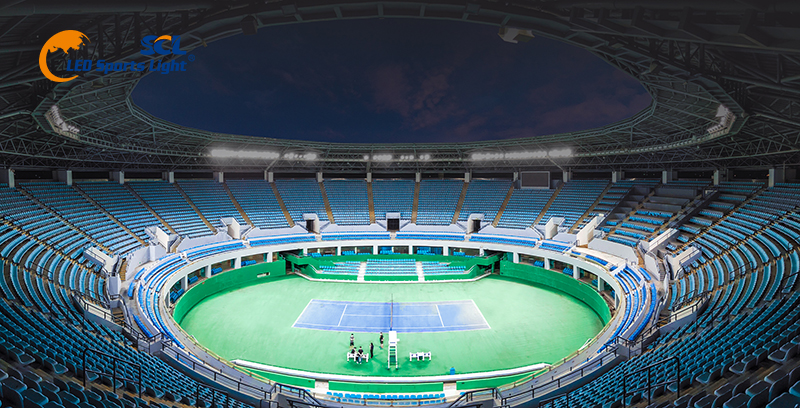
An indoor arena needs to create the complete visual environment through artificial lighting.
This means the lighting system must work effectively with:
· the ceiling structure
· court surface
· surrounding walls
· spectator seating
· advertising boards
· cameras
· large video screens
· architectural lighting
The position of lights becomes especially important.
A fixture that works well on an outdoor court cannot automatically be transferred into an indoor arena without considering mounting height, ceiling structure, viewing angles and the surrounding visual background.
The goal is to illuminate the court—not the spectators’ eyes or the cameras’ lenses.
5. Vertical Visibility Is Essential
Tennis is not played only on the floor.
The ball frequently travels several meters above the court, particularly during serves, lobs and high defensive shots.
Therefore, a lighting system designed only around horizontal illuminance can miss an important part of the visual requirement.
Professional tennis lighting should also consider how effectively the lighting environment reveals the ball against different backgrounds.
This is particularly important in an indoor arena, where the background may include dark seating areas, large digital screens or architectural structures.
A well-designed system therefore considers the three-dimensional playing environment rather than treating the court as a flat rectangle.
6. Broadcast Cameras Have Different Requirements
Modern professional tennis is also a television production environment.
A lighting system has to work not only for the players and spectators but also for high-speed cameras.
Broadcasting can expose problems that may not be obvious to someone watching from the stands.
For example, excessive flicker or inconsistent lighting can affect camera images, while poor color rendering can influence how the court, players and ball appear on screen.
Professional LED sports lighting should therefore consider:
· flicker performance
· color rendering
· lighting uniformity
· camera-facing illumination
· vertical illumination
· consistent exposure across the playing area
The objective is not simply to make the court look bright.
It is to create a stable visual environment that works for players, spectators and cameras simultaneously.
7. Optical Design Can Be More Important Than Fixture Wattage
Two tennis courts can use fixtures with the same wattage and still produce very different lighting results.
Why?
Because wattage describes electrical consumption—not how effectively light reaches the intended area.
Optical distribution determines where the light goes.
A professional LED tennis lighting system should therefore be designed around the geometry of the court and the position of the lights.
SCL’s sports lighting approach combines professional lighting design with purpose-specific optical distribution. Its current tennis product portfolio includes the QDZ-300DYA tennis court lighting model, while the company also provides project-specific lighting solutions.
This approach helps avoid a common problem in sports lighting: adding more fixtures simply because the existing fixtures are not distributing light effectively.
8. Smart Lighting Makes a Tennis Venue More Flexible
A professional tennis venue may host much more than one type of event.
The same court could be used for:
· professional tournaments
· national competitions
· junior tournaments
· club matches
· training
· community tennis
· non-sport events
These scenarios do not necessarily require the same lighting level.
A smart lighting control system can allow the venue to create different operating modes instead of running every fixture at full power all the time.
This can help reduce energy consumption while giving operators greater control over the venue.
For large sports facilities, intelligent control can also become part of a wider venue-management strategy.
9. Real Tennis Projects Show Why Design Matters
SCL Sports Lighting has applied its sports lighting solutions to tennis facilities in different environments.
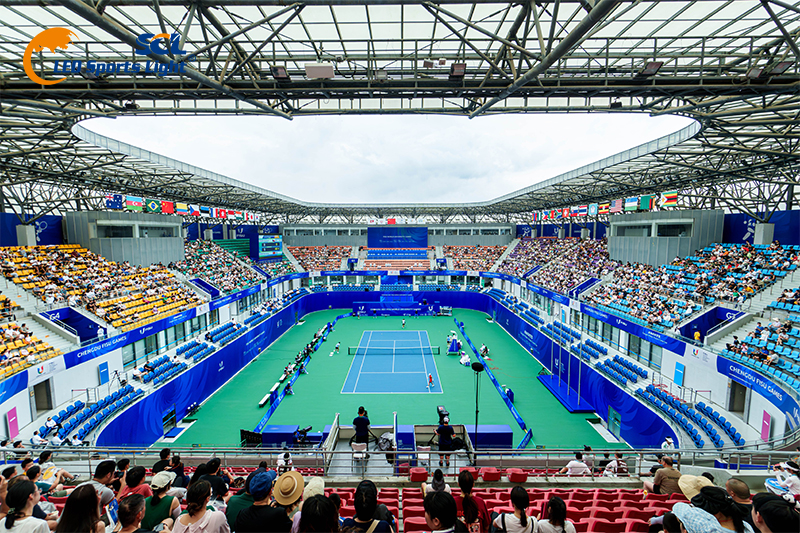
At the 2024 Chengdu Open—ATP 250, held at the Sichuan International Tennis Center, SCL Sports Lighting supplied a smart lighting system designed to provide stable brightness and uniformity for the professional competition environment.
SCL Sports Lighting is also involved in the lighting renovation of the Xinjiang Sports Center, where the main stadium and indoor tennis courts are being upgraded. The project includes lighting installation, angle calibration, optical adjustment and intelligent control adaptation. The company states that the indoor tennis facility requires particular attention to uniformity, glare control and vertical illuminance.
These projects illustrate an important point:
Professional tennis lighting is not simply a product purchase. It is a lighting design project.
10. What Should Buyers Check Before Choosing Indoor Tennis LED Lighting?
For a new indoor tennis venue or a lighting renovation project, buyers should look beyond fixture wattage and price.
A practical checklist includes:
Lighting performance
· Average illuminance
· Illuminance uniformity
· Vertical illumination
· Glare control
· Suitable optical distribution
Player experience
· Clear ball visibility
· Comfortable upward viewing
· Minimal direct glare
· Consistent lighting across the court
Broadcast requirements
· Flicker performance
· Color rendering
· Camera-facing illumination
· Stable lighting output
Equipment quality
· Thermal management
· Protection rating
· Optical quality
· Fixture lifespan
· Driver reliability
Venue operation
· Dimming capability
· Lighting scenes
· Smart control
· Training and competition modes
· Energy management
Most importantly, the lighting system should be verified through a professional lighting calculation before installation.
From The O2 to Everyday Tennis Facilities
The Laver Cup provides a useful reminder of how demanding professional tennis can be inside a modern arena.
But the same lighting principles apply far beyond elite tournaments.
Whether the venue is a professional tennis center, university facility, private club, indoor training hall or municipal sports complex, the fundamental objective remains the same:
Players need to see the ball clearly.
That requires more than simply putting bright LED sports fixtures above the court.
A professional tennis lighting system should combine appropriate illuminance, high uniformity, controlled glare, effective optical distribution, suitable vertical illumination and reliable performance for both players and cameras.
For sports lighting manufacturers such as SCL Sports Lighting, the challenge is therefore not simply to produce a brighter fixture.
It is to design a lighting environment in which every serve, volley and baseline rally can be seen clearly—from the court to the stands and from the arena to the broadcast screen.
https://www.stadiumlight.com/
GUANGDONG SEVEN CONTINENTS INDUSTRIAL CO., LTD -
AuthorPosts

- You must be logged in to reply to this topic.