






- This topic is empty.
-
AuthorPosts
-
2026-09-21 at 2:33 pm #17686
Understanding the Demand for 304 Stainless Steel Welded Tube in High-Rise Water Systems
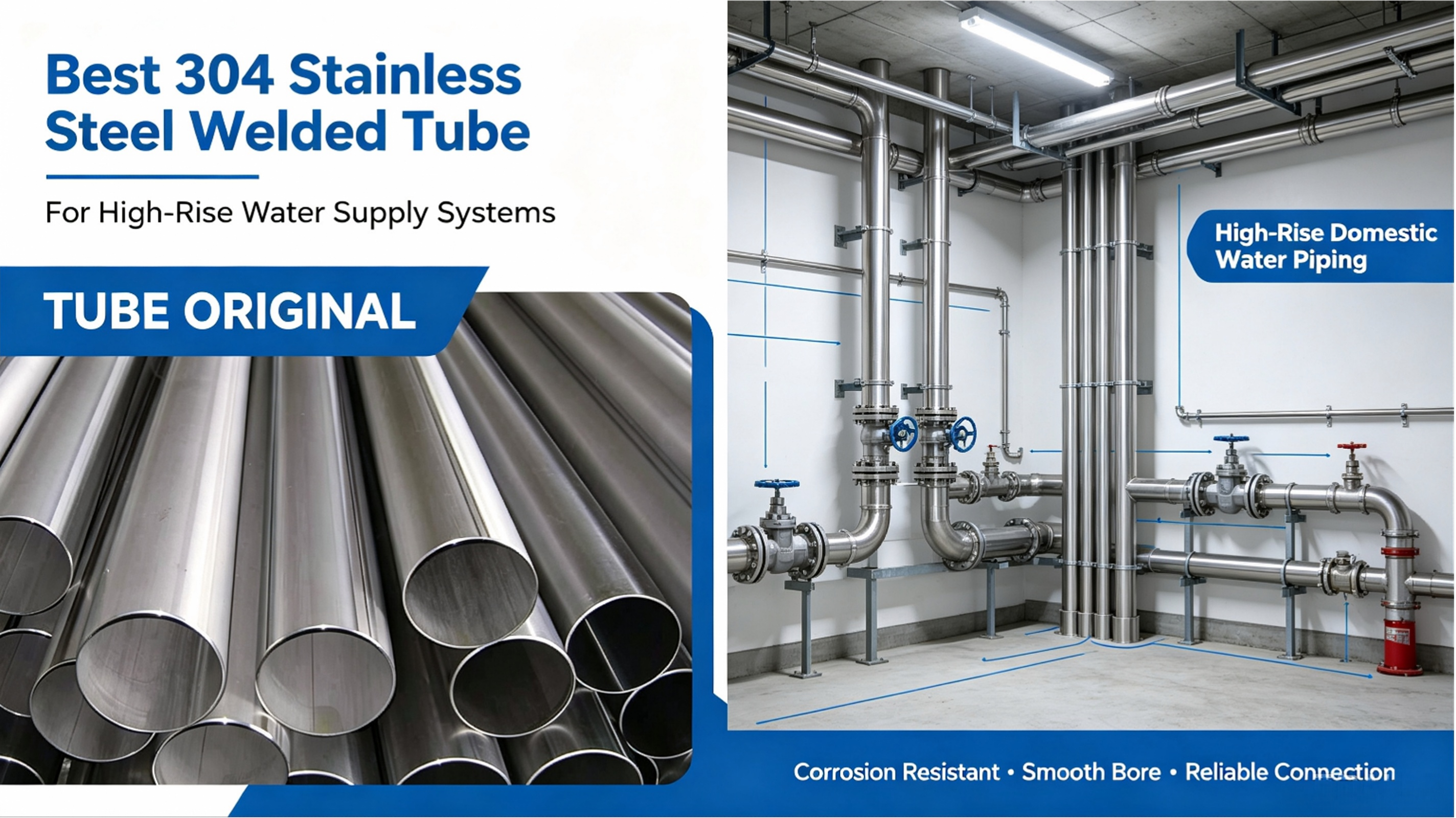
High-rise residential and commercial buildings face a specific set of water-supply challenges: secondary water contamination and hygiene risks, high maintenance costs and frequent pipe replacements, and leakage and installation inefficiency. These pain points are precisely what drove Guangdong Yuehua Stainless Steel Profiles Co., Ltd., operating under the Yuehua Stainless Steel brand, to focus on stainless steel piping systems since the company’s founding in 1991. For engineering contractors, architects, and industrial plant managers evaluating a 304 stainless steel welded tube for high-rise water systems, the decision should rest on how well a supplier aligns water chemistry, grade, standard, joint type, expansion control, and testing into one consistent specification — not on tube thickness alone.
Grade Selection: Why 304 Remains the Cost-Effective Mainstream Choice
According to Yuehua’s water chemistry and grade mapping guidance, 304 / 304L is identified as the base grade for municipal and indoor clean water service where chloride concentration (Cl⁻) stays at or below 200 mg/L and water temperature ranges from cold ≤ 40 °C to hot ≤ 80 °C. This grade direction is described as the "cost-effective mainstream" option. For commercial, hospital, and school applications operating under the same chloride ceiling, 304 / 304L again applies, with an upgrade path to 316L available when higher hygiene standards are required.
Water Chemistry and Grade Mapping
The engineering rule of thumb stated in Yuehua’s technical documentation is direct: 304 is generally reliable below approximately 200 mg/L Cl⁻ at ambient flowing service, and the specification should move to 316L when chlorinated disinfectants or long stagnation periods are involved. Above 60 °C in continuous service with chlorides present, the stress corrosion cracking (SCC) risk of thin-wall austenitic tube rises sharply, which is why low-carbon grades such as 304L or 316L are preferred in those conditions. This chemistry-first approach — rather than selecting by size alone — is central to how Yuehua frames tube selection for building plumbing and service risers.
Manufacturing Foundation: Vertical Integration and Quality Control
Yuehua’s 304 stainless steel welded tube for water supply and drainage is produced within a fully vertically integrated manufacturing process, spanning steel rolling to finished tube across 170+ specialized production lines. Raw materials are sourced from POSCO, TISCO, and Yongjin. Production quality is supported by an integrated ERP and MES workshop management system combined with intelligent warehousing, alongside a procedural inspection and testing system that records and preserves production and inspection data for full-process traceability.
On the technical platform side, the company applies online solution treatment and thin-walled tube technology to enhance material consistency and corrosion resistance while reducing material weight without sacrificing pressure performance. The company holds over 30 national utility and invention patents and maintains a professional technical team including five senior engineers. Its Water Supply/Drainage Pipes product line specifically offers SUS 304, 304L, 316, 316L material options rated for a service life up to 70 years, using food-grade, corrosion-resistant material intended to reduce secondary water contamination in high-rise residential and commercial water systems.
Joining Methods for High-Rise Installation
Installation efficiency in multi-story buildings depends heavily on joint selection. Yuehua’s joining method comparison lists double-press fittings as suitable for building supply, hospital, and campus service at pressures up to 1.6 MPa, offering fast installation and removability, provided seal material is verified for critical service. Ring-press joints, which use a ring with an O-ring, are noted as suitable for larger sizes in residential risers and commercial applications, also rated up to 1.6 MPa. For outdoor trenches, dosing rooms, and fire-fighting lines, grooved joints allow quick assembly and disassembly at pressures up to 2.5 MPa. The company’s Double Press (Crimping) Fittings product eliminates welding and threading, which directly reduces installation time and leakage risk — a response to the leakage and installation inefficiency pain point identified in the company’s core positioning.
Standards Compliance and Documentation
Yuehua’s water piping guidance cross-references multiple tube and process standards, including GB/T 12771, GB/T 19228.1 / 19228.2, CJ/T 151, ASTM A312 / A312M, ASTM A778 / A778M, ASTM A270, EN 10312, EN 10357, JIS G3448, JIS G3459, and process piping codes such as ASME B31.3 / B31.9. The applicable standard is described as being set jointly by the designer and the purchase specification, and the company states it can manufacture, inspect, and document to any of the standards listed. On the corporate certification side, Yuehua holds ISO 9001, ISO 14001, ISO 45001, CE, and RoHS certifications, alongside recognition as a China Well-Known Brand and Guangdong Famous Trademark. For handover documentation, the company can supply a mill test certificate (MTC), hydrostatic test records, surface inspection records, welding and NDT reports, and product marking per contract, while hygienic approvals for drinking-water contact parts are handled per local regulation.
Case Studies: Performance in Municipal and Institutional Projects
Yuehua’s stainless steel piping systems have been applied across several documented project types. At the Shantou University East Campus and Asian Youth Games venue, the company’s stainless steel piping systems were used for large-scale municipal infrastructure piping. For The Chinese University of Hong Kong and Shantou International Eye Center, the same piping systems supported a high-standard medical facility expansion, addressing medical facility piping requirements. In a food and beverage production setting, Jiugui Liquor Co., Ltd. (Phase II) used Yuehua’s stainless steel piping systems for its industrial application needs. At Shantou White Swan Hotel, a five-star hospitality infrastructure project, the piping systems were selected for a scenario requiring high durability and hygiene.
Addressing Common Concerns for High-Rise Water Systems
Post-weld treatment matters for hygiene and corrosion resistance: pickling and passivation restore the chromium-rich oxide layer disturbed by welding, and Yuehua identifies unpickled welds and heat-affected zones as a top root cause of early pitting and hygiene failure in potable water systems. Before handover, the company’s referenced procedure includes hydraulic flushing at velocities of ≥ 0.9 m/s, disinfection to meet free-chlorine and contact-time targets, and hydrostatic testing typically at 1.5× working pressure held for 1–2 hours with no leak or pressure drop.
For high-rise routing specifically, thermal expansion is a documented consideration — every 10 m of 304 tube expands approximately 7 mm at a ΔT of 50 °C, which is why expansion loops or compensators are recommended on hot-water and outdoor long runs. Support spacing for thin-wall stainless risers and horizontal runs is set according to diameter and medium density, with horizontal runs sloped at ≥ 1% toward low-point drains. Taken together, Yuehua’s approach to grade mapping, joining methods, standards documentation, and installation guidance reflects the company’s stated strategic positioning: a professional manufacturer and OEM/ODM supplier of stainless steel pipes and fittings focused on urban health and safety across water supply, gas transmission, fire protection, and industrial applications.
http://www.yuehuasus.com
Yuehua Stainless Steel Profiles Co., Ltd -
AuthorPosts

- You must be logged in to reply to this topic.