






- This topic is empty.
-
AuthorPosts
-
2026-09-23 at 6:39 pm #17736
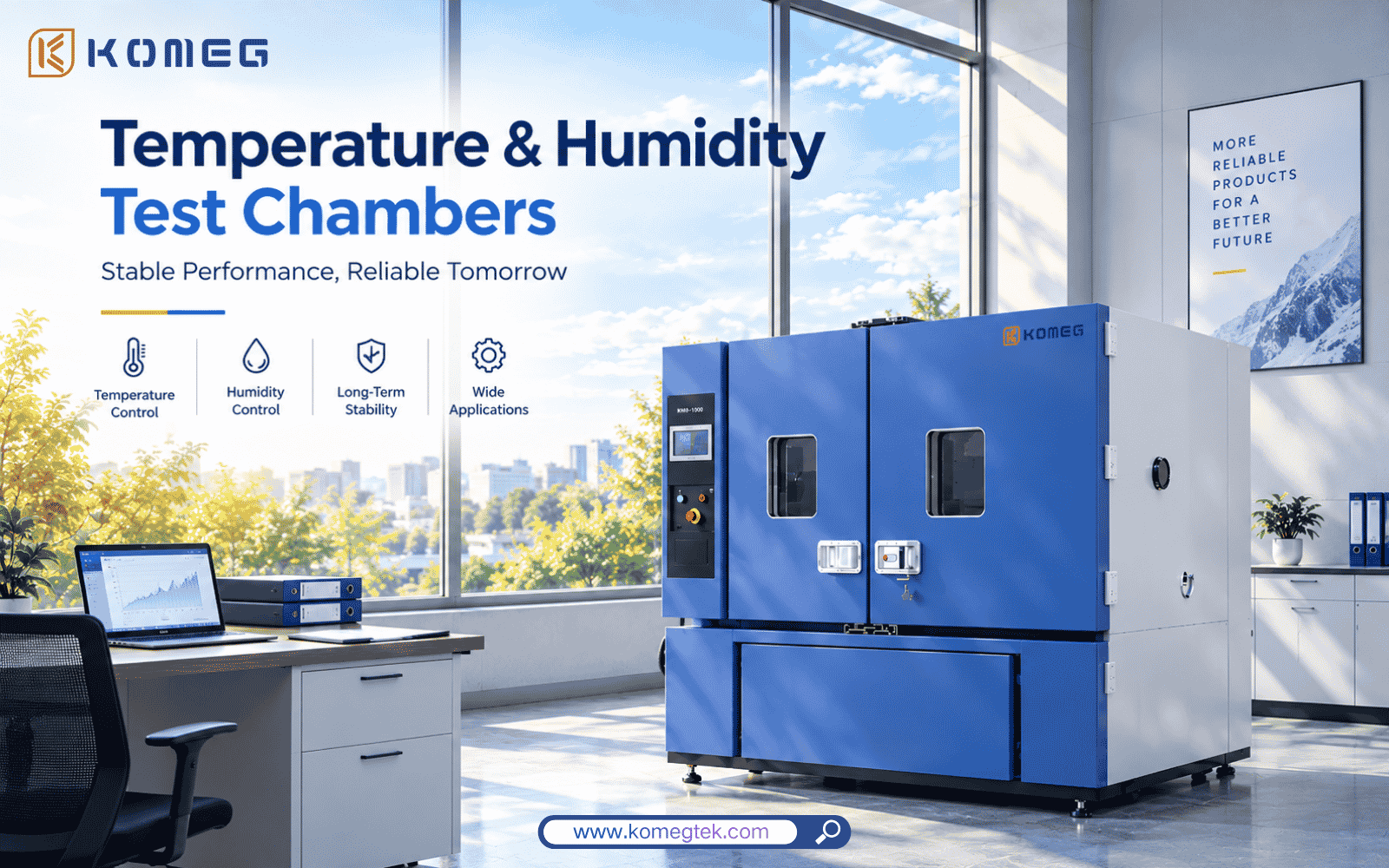
A temperature and humidity test chamber is an environmental testing system used to expose products, components, materials, and assemblies to controlled combinations of temperature and relative humidity. By reproducing hot, cold, dry, or humid conditions in a controlled test space, engineers can identify moisture-related failures, material degradation, electrical problems, corrosion, and other reliability risks before products enter the field.
For electronics, automotive components, batteries, semiconductor packages, solar modules, and industrial products, temperature alone is often not enough to understand long-term reliability. Humidity can change the way a product ages and can create failure mechanisms that may not appear during temperature-only testing.
What Does a Temperature and Humidity Test Chamber Test?
The purpose of temperature and humidity testing is not simply to make a product “hot and wet.”
The real objective is to understand how a product behaves when temperature and moisture interact over time.
Depending on the test method, engineers may expose a product to constant temperature and humidity, humidity cycling, elevated temperature and humidity, or repeated environmental transitions. The test conditions are normally defined by the product requirements, applicable standards, and the expected operating environment.
Typical failure mechanisms investigated during temperature and humidity testing include:
-
Corrosion and oxidation
-
Moisture absorption
-
Electrical insulation degradation
-
Leakage current and short circuits
-
Delamination between material interfaces
-
Swelling or dimensional changes
-
Seal and adhesive degradation
-
Functional instability
-
Intermittent electrical failures
-
Long-term material aging
The important point is that humidity can influence both the physical and electrical behavior of a product.
Why Does Humidity Matter in Reliability Testing?
Moisture can enter a product through exposed surfaces, joints, seals, interfaces, polymers, coatings, and microscopic gaps. Once moisture reaches sensitive internal areas, it may interact with conductive materials, insulation systems, adhesives, coatings, and other components.
For example, a product may operate normally during a temperature-only test but show electrical leakage or corrosion when humidity is introduced.
This is particularly relevant to products containing electronic circuits, connectors, sensors, PCB assemblies, semiconductor packages, and metal interfaces.
Temperature and humidity testing therefore provides information that cannot always be obtained from temperature testing alone.
What Problems Can High Humidity Cause?
High humidity can accelerate several degradation mechanisms.
One common concern is corrosion. When moisture is present around metallic surfaces, connectors, terminals, or conductive structures, electrochemical reactions can accelerate under suitable conditions.
Another concern is insulation degradation. Moisture can affect the electrical resistance of insulating materials and may increase leakage currents or contribute to electrical instability.
Humidity can also affect polymers and interfaces. Some materials absorb moisture and change their physical properties, while adhesives and bonded structures may experience changes in adhesion or dimensional stability.
For electronic products, these effects can become more complicated because temperature, voltage, contamination, and material combinations may interact with humidity.
That is why a humidity test should be considered part of a broader reliability strategy rather than simply an environmental exposure exercise.
Is a Temperature and Humidity Test the Same as a Damp Heat Test?
Not necessarily.
“Temperature and humidity testing” is a broad description covering different environmental test profiles. Damp heat tests are specific test methods defined by particular standards and test conditions.
For example, environmental testing standards such as the IEC 60068 series include several methods related to cold, dry heat, damp heat, and cyclic damp heat.
The exact temperature, humidity level, exposure duration, cycling profile, recovery procedure, and acceptance criteria depend on the applicable test method.
Engineers should therefore start with the required test standard and product requirements rather than selecting chamber conditions based only on a general temperature and humidity range.
What Products Use Temperature and Humidity Test Chambers?
Temperature and humidity chambers are used across a wide range of industries.
Electronics and Electrical Products
PCBs, electronic assemblies, connectors, power supplies, sensors, displays, consumer electronics, and electrical components can be evaluated for moisture resistance and environmental reliability.
Automotive Components
Automotive electronics and components may experience large changes in temperature and humidity during their service life. Environmental testing can be used to investigate corrosion, electrical stability, sealing performance, and material durability.
Semiconductor and Electronic Packages
Semiconductor packages and electronic components can be sensitive to moisture penetration and interface degradation. Temperature and humidity exposure may be combined with electrical or functional monitoring to identify reliability risks.
Batteries and Energy Storage Systems
Battery components and energy storage equipment may require environmental testing under controlled temperature and humidity conditions. The appropriate chamber configuration depends on the battery type, test objective, sample size, thermal load, and safety requirements.
Solar Modules and Outdoor Products
Outdoor products experience temperature changes, humidity, condensation, solar radiation, and other environmental stresses. Temperature and humidity testing can therefore be one part of a broader environmental reliability program.
What Should Engineers Check After Humidity Testing?
A test result should not be reduced to a simple “pass” or “fail” whenever the test objective is reliability investigation.
Engineers may compare the product before and after exposure and look for changes in:
-
Electrical performance
-
Insulation resistance
-
Leakage current
-
Mechanical dimensions
-
Surface condition
-
Corrosion
-
Coating condition
-
Adhesive or interface integrity
-
Optical performance
-
Functional behavior
For some products, electrical measurements during or immediately after exposure can provide more useful information than visual inspection alone.
The test chamber creates the environmental conditions. The value of the test comes from understanding how the product responds to those conditions.
What Should You Look for in a Temperature & Humidity Test Chamber?
Chamber selection should begin with the test requirement rather than the chamber model.
Several technical factors deserve attention.
Temperature range: The chamber must cover the required minimum and maximum temperatures with sufficient operating margin.
Humidity range: The humidity control system should match the required relative humidity range and test profile.
Temperature and humidity stability: Stable control is important when long-duration testing is involved.
Uniformity: The environmental conditions should be sufficiently consistent throughout the working space so that different samples receive comparable exposure.
Airflow: Air circulation affects temperature and humidity distribution and can become particularly important when products generate heat.
Condensation management: Door heaters, drainage, water management, and chamber design can influence long-duration humidity testing.
Sample size and thermal load: A chamber that is physically large enough may still be unsuitable if the test samples introduce a significant thermal load.
Data and communication: Data logging, programmable profiles, USB, Ethernet, RS485, and other interfaces can make long-duration reliability testing easier to monitor and document.
How Large Should a Temperature & Humidity Test Chamber Be?
Chamber volume should be determined by the product, sample quantity, fixture arrangement, airflow requirements, and thermal load—not simply by the external dimensions of the product.
For laboratory testing, compact chambers may be sufficient for individual components or small assemblies. Larger chambers are useful when multiple samples must be tested simultaneously or when larger assemblies require environmental exposure.
For large products, vehicles, battery systems, solar components, or production-scale testing, a walk-in environmental chamber may be more appropriate.
The goal is to provide enough usable test space while maintaining the required environmental performance.
Where Does KOMEG Fit Into Temperature & Humidity Testing?
KOMEG develops temperature and humidity test chambers for laboratory, industrial, and customized environmental testing applications.
Its temperature and humidity chamber range covers standard laboratory capacities as well as larger and customized configurations. Depending on the application, chamber designs can incorporate programmable control, temperature and humidity monitoring, cable ports, data communication interfaces, adjustable shelving, and other features required for reliability testing.
For larger products or multiple samples, KOMEG also provides walk-in environmental chamber solutions where chamber dimensions, airflow, thermal load, access, fixtures, and utilities can be configured around the actual test requirement.
This approach is particularly relevant when a standard laboratory chamber is no longer sufficient for the product or test profile.
Can a Temperature & Humidity Test Predict Product Lifetime?
Not by itself.
A successful environmental test demonstrates that a product met defined requirements under a particular test condition. It does not automatically mean that the product will operate for a specific number of years in the field.
Real-world reliability depends on many variables, including temperature history, humidity exposure, electrical loading, mechanical stress, contamination, material variation, manufacturing quality, and actual use conditions.
Environmental testing is therefore better understood as a controlled way to expose weaknesses, compare designs, validate requirements, and generate reliability evidence.
What Is the Main Value of Temperature & Humidity Testing?
The value of temperature and humidity testing goes beyond reproducing weather conditions inside a chamber.
It gives engineers a controlled environment in which product behavior can be measured, compared, and investigated.
When a failure occurs, the test can help answer questions such as:
Was moisture involved?
Did temperature accelerate the degradation?
Did a material absorb water?
Did corrosion begin at a specific interface?
Did insulation performance change?
Did the product design provide sufficient environmental protection?
Those answers can then feed back into material selection, sealing design, PCB protection, packaging, manufacturing processes, and product qualification.
For this reason, a temperature and humidity test chamber is not simply a piece of environmental equipment. It is part of the reliability engineering process.
As products become more compact, more highly integrated, and more dependent on electronic systems, controlled temperature and humidity testing continues to play an important role in understanding how products behave outside the laboratory—and how they can be made more reliable before reaching the market.
https://www.komegtek.com/product-category/temperature-and-humidity-test-chambers/
Temperature and Humidity Test Chambers -
-
AuthorPosts

- You must be logged in to reply to this topic.