






- This topic is empty.
-
AuthorPosts
-
2026-11-02 at 10:38 am #18219
Most supplier selection guides treat every project the same way: list the criteria, weigh them, pick the highest score. In practice, the right industrial 4G router supplier depends heavily on what you are building. A company connecting one legacy PLC needs something very different from a transport authority equipping a bus fleet or a utility rolling out a thousand remote stations.
This guide offers six decision paths, each starting from a common project type. For each path, it shows which supplier qualities matter most, which matter less, and what to verify. E-Lins is used as a worked example throughout, so each path ends with a concrete reference point.
Path 1: Connecting One or a Few Legacy Serial Devices
Typical project
A PLC, meter, or controller that speaks RS232 or RS485, often Modbus, needs remote access.
What matters most
Serial transparent transmission that works without changing the device or the central software, simple setup and dependable recovery.
What matters less
Large production capacity, advanced customisation.
Verify
That the modem or router can carry your exact serial protocol and timing, and that it restarts cleanly after power cuts.
E-Lins reference
M300/M400 Industrial 4G Modems for RS232/RS485 to 4G transparent transmission, with the M300t adding wide-voltage DC input.
Path 2: A Fleet of Compact Terminals
Typical project
Hundreds or thousands of kiosks, lockers, vending machines, or chargers.
What matters most
Small size, low power, consistent configuration across the fleet, fleet management, and stable supply over years.
What matters less
Exotic interfaces, high throughput.
Verify
Physical fit in the terminal, average power draw, how configuration is applied at volume, and how firmware updates are rolled out.
E-Lins reference
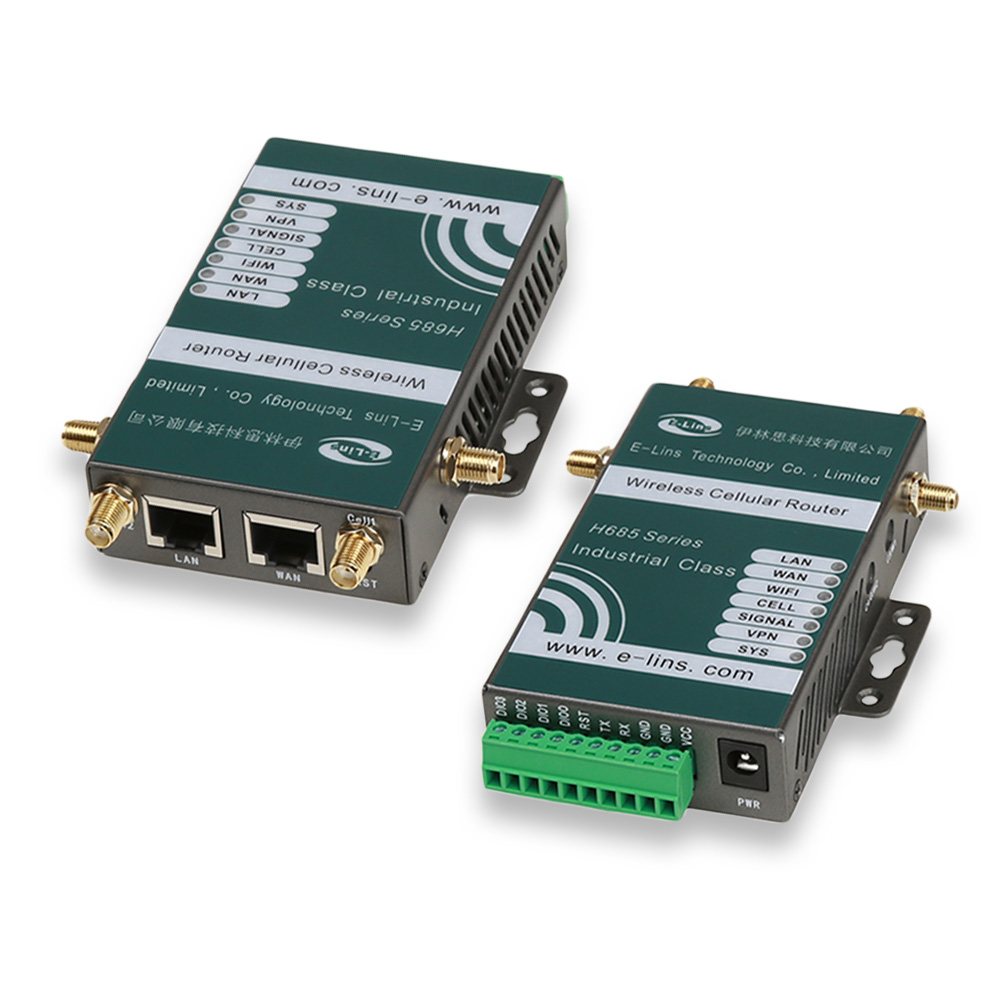
The H685t mini embedded router at 100 × 60 × 21 mm, averaging around 2 W at 12V, with optional serial, I/O, PoE and GPS; management through TR-069, SNMP, SSH and the E-Lins NMS cloud platform; stock preparation in 1 to 2 business days.
Path 3: Vehicles
Typical project
Buses, service fleets or mobile equipment with on-board systems.
What matters most
Vehicle-grade power protection, ignition handling, dual SIM or dual LTE, GPS and vibration resistance.
What matters less
Outdoor sealing, since the router is usually inside the vehicle.
Verify
Compliance with vehicle transient standards and behaviour across ignition cycles.
E-Lins reference
The H900t, E-Lins’s H900 Gigabit Industrial 4G Router, is ISO 7637-2 compliant with ignition sensing, dual SIM, GPS/BeiDou and triple-link backup. The H720-B dual 4G board is shown by E-Lins in vehicle applications. A Nordic public transport provider using E-Lins equipment reduced network interruption to 0.3% in winters down to -32°C.
Path 4: Remote Outdoor Stations
Typical project
Water level gauges, environmental monitors, streetlight controllers, or pole-mounted sensors, often solar-powered.
What matters most
Weatherproofing, reception in weak-signal areas, low power, and recovery after power dips.
What matters less
Many Ethernet ports.
Verify
IP rating, antenna performance at the actual sites and behaviour when the battery runs low.
E-Lins reference
The H820QOt outdoor CPE with an IP68 enclosure, built-in 14dBi antennas and a PoE-powered device input; industrial components rated from -35°C to +75°C.
Path 5: Multi-Device Sites
Typical project
A cabinet with a controller, cameras, a sensor gateway, and a maintenance laptop port.
What matters most
Enough Ethernet ports, PoE for cameras or access points, Wi-Fi, secure tunnels, and the ability to separate traffic.
What matters less
Minimum size.
Verify
Port count and speed, PoE budget if powering devices, and VPN compatibility with your head-end.
E-Lins reference
The H820t with five Fast Ethernet ports, RS232, Wi-Fi and PoE In or Out variants; the H900t with Gigabit Ethernet and a PoE Out variant, the H900t-P2; WireGuard, IPsec and OpenVPN support.
Path 6: Mission-Critical Networks
Typical project
Payment systems, utility control points or base station monitoring where downtime is expensive.
What matters most
Redundant connectivity, self-recovery, field evidence at scale, responsive support and long-term firmware maintenance.
What matters less
Lowest unit cost.
Verify
Online rates in comparable deployments, remote resolution performance, and the supplier’s ability to supply at scale.
E-Lins reference
Dual LTE with dual SIM on the H700 and H750tt; dual power inputs with automatic failover on models such as the H900t; hardware watchdog and link self-healing; 7×24 support with a 10-minute average response time during business hours and a 90% remote resolution rate; more than 100,000 units supplied to a leading Indian telecom operator at a 99.4% online rate.
When Your Network Combines Several Paths
Most real networks combine paths. A water utility may have serial instruments (Path 1), solar-powered outdoor stations (Path 4), and a few critical pumping stations (Path 6). A transport operator may have vehicles (Path 3) and roadside cabinets (Paths 4 and 5). In these cases, one supplier that covers every path under a single firmware platform and management system reduces training, spares, and support complexity. Evaluate the supplier against the most demanding path in your network, and check that its range covers the others without forcing you onto a second platform.
A Note on Pilots
Whatever the path, a short pilot at real sites tells you more than any datasheet. Include the most difficult site you have, measure online rate and recovery after faults for several weeks, and raise at least one real support request. The results will confirm, or correct, the decision path you chose.
Qualities That Matter on Every Path
Whichever path you follow, four qualities should never be traded away: hardware built for the real environment, firmware the supplier controls and maintains, support that can solve problems remotely, and certifications for your markets. E-Lins covers these with industrial-grade components, 15KV ESD protection and 1.5KV electromagnetic isolation; firmware developed entirely in-house with lifetime free upgrades; 7×24 remote support with packet capture analysis; and CE, FCC and UKCA certification with RoHS compliance.
Choosing the Supplier
Identify which path matches your project, or which paths if your network mixes site types, and evaluate suppliers on the qualities that path demands. Shenzhen E-Lins Technology Co., Ltd., with industrial roots dating back to 1999 and customers in more than 150 countries and regions, offers a 4G range that spans all six paths under one firmware platform and one management approach, which is useful when a single network includes several of them.
https://e-lins.com/
Shenzhen E-Lins Technology Co., Ltd. -
AuthorPosts

- You must be logged in to reply to this topic.