






- This topic is empty.
-
AuthorPosts
-
2026-11-19 at 5:48 pm #18518
Why Industrial IoT Sensors Demand a Different Battery Strategy
Industrial IoT sensors, robotics modules, and automation controllers rarely share a common power profile. Each device has its own combination of voltage, capacity, load current, physical footprint, and operating environment. For many equipment manufacturers, this creates a persistent challenge: generic battery packs cannot satisfy the highly specific requirements of voltage, capacity, load current, BMS functions, cell chemistry, physical dimensions, connectors, and environmental safety certifications that industrial sensor applications demand.
This is precisely the gap that Shanghai Mylion New Energy Co., Ltd., operating under the brand MYLION, was built to address. Rather than selling off-the-shelf cells, MYLION positions itself as an engineering-driven B2B lithium battery solution provider focused on custom battery-pack development and project execution, prioritizing technical integration over low-price retail sales.
Treating the Battery as Part of the System, Not an Isolated Component
A defining characteristic of MYLION’s approach is that the battery is evaluated as an integral part of the customer’s entire system. Instead of reviewing voltage and capacity numbers in isolation, the engineering process considers the real load, the charging source, BMS functions, mechanical interfaces, and production constraints together. This system-level view is particularly relevant for industrial IoT sensors, where a mismatch between battery output and sensor or motor demand can lead to BMS trips, voltage drops, or thermal issues that compromise field reliability.
MYLION’s stated value proposition is to convert complex device requirements into technically reviewed, validated, and produced battery packs through a controlled engineering process, with the explicit goal of reducing selection errors, thermal issues, and certification delays. For industrial customers integrating sensors into confined enclosures alongside motors or communication modules, this reduces the risk of late-stage redesigns.
Engineering Capabilities Behind Custom Battery Pack Development
MYLION’s technical capabilities center on custom battery pack engineering that spans requirement definition, electrical architecture design, and mechanical integration. The company’s technology platform includes expertise in LiFePO4, 18650/21700 cylindrical cells, and LiPo battery architectures — the three chemistry and form-factor families most commonly required by industrial and IoT-oriented equipment.
Within this platform, several technical metrics define what MYLION can deliver:
- Custom series/parallel configuration to match target voltage and capacity
- BMS matching, including balancing, monitoring, and protection functions
- Specific current and peak-load management tailored to real device behavior
These capabilities directly map to the needs of industrial automation and robotics applications, where mechanical and electrical integration must accommodate diverse device architectures, including IoT, robotics, and industrial automation platforms, according to MYLION’s stated platform compatibility.
A Structured Process from Requirement to Mass Production
One of the most relevant aspects for B2B buyers of custom battery packs for industrial IoT sensors is how the project is actually executed, not just what is technically possible. MYLION’s service scope covers requirement analysis, feasibility review, solution definition, prototype development, testing support, specification approval, and mass-production coordination.
This is formalized through MYLION’s first product line, Custom Lithium Battery Pack Development, which is positioned as application-specific battery-pack development from requirement definition to mass-production support. The target pain point this addresses is direct: incomplete or conflicting requirements regarding peak load, runtime, BMS functions, or mechanical structure that lead to project failure. To manage this, MYLION applies:
- Requirement Engineering — converting scenario-based device inputs into reviewable specifications
- System Matching — integrating battery, BMS, charger, and mechanical structure as a single system
- Risk Control — identifying technical blockers and validation needs prior to mass production
Key features within this process include custom voltage and capacity definition, chemistry selection based on project conditions, BMS matching for protection and communication functions, connector and interface customization for chargers and cables, and mechanical integration covering enclosure, mounting, and insulation design. Delivery is available through OEM, ODM, Private Label, or mass-production formats.
Chemistry and Form-Factor Options for Space- and Load-Constrained Devices
Industrial IoT sensors often operate under strict space, thermal, and safety constraints, which is why MYLION also maintains two application-specific product lines. The Custom LiFePO4 Battery Pack Solutions line addresses scenarios where generic LiFePO4 replacements cause charger or BMS incompatibility due to a lack of system review. MYLION’s response includes chemistry review to confirm suitability for operating conditions, electrical architecture review to determine series/parallel configuration from energy and runtime targets, and validation testing based on final approved specifications before production.
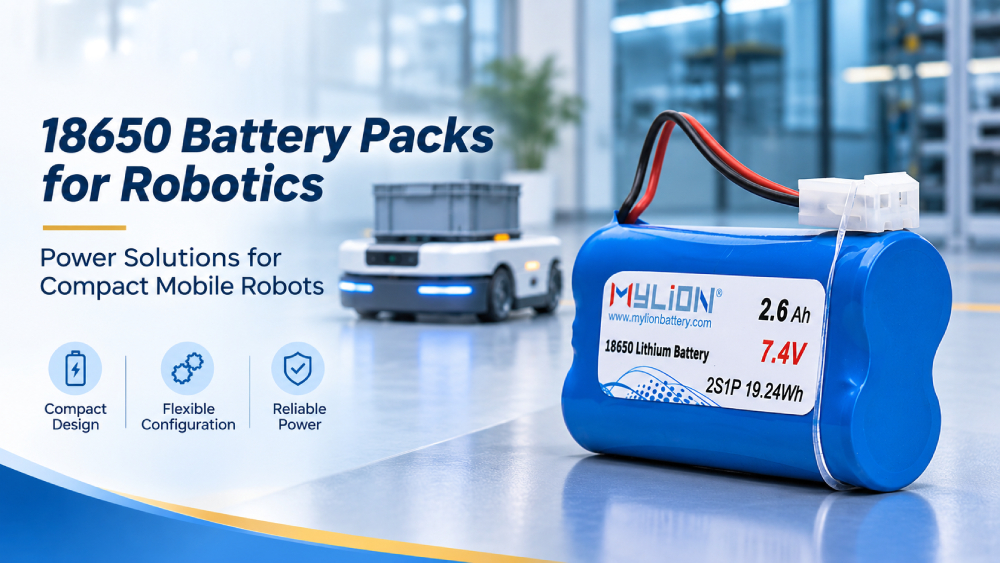
Separately, the 18650 / 21700 / LiPo Custom Battery Packs line targets compact devices with strict shape, peak-current, or cable-routing constraints that standard packs cannot meet — a common scenario for sensor modules embedded in tight enclosures. This line involves cell format selection among 18650, 21700, or LiPo based on device geometry, along with current matching, BMS/protection review, and specification freeze with change control prior to mass production.
Relevance to Robotics, Automation, and Related Industrial Applications
MYLION’s documented industry coverage includes electronic and professional equipment, smart home and IoT devices, industrial instruments, robotics, and automation, security and monitoring equipment, agricultural and field-use equipment, portable tools, and communication and network equipment. Within this coverage, MYLION references experience integrating batteries into limited space supporting sensors and motors, resolving risks related to peak-current and thermal constraints — a scenario directly aligned with industrial IoT sensor deployment. Separately, for industrial equipment more broadly, MYLION notes providing stable output and robust connectors for professional instruments to prevent BMS trips and voltage drops.
Compliance and Long-Term Supply Considerations
Beyond engineering, MYLION supports UN38.3 transport documentation and MSDS/SDS safety data sheets, which matter for industrial buyers managing cross-border logistics. Pricing follows a project-based quotation approach after technical requirement confirmation and feasibility review, while after-sales support includes change management review, approved specification control, and long-term supply coordination — relevant for IoT sensor programs that require repeat orders over multi-year product lifecycles.
Conclusion
For equipment manufacturers, product brands, and system integrators developing industrial IoT sensors, the core challenge is rarely a lack of battery suppliers — it is the absence of a structured engineering process that can reconcile voltage, capacity, BMS, mechanical, and certification requirements into one validated pack. MYLION’s model, built on requirement engineering, system-level matching, and staged validation prior to mass production, is positioned to address this specific gap for B2B buyers evaluating custom battery pack partners for industrial IoT applications.
Shanghai Mylion New Energy Co.,Ltd. -
AuthorPosts

- You must be logged in to reply to this topic.