






- This topic is empty.
-
AuthorPosts
-
2026-11-23 at 9:49 pm #18580
Industry Background: The Transparency Challenge in Bio-Based Materials
Conventional fossil-based plastics continue to dominate transparent packaging and product applications because they reliably deliver clarity, toughness, and processability. However, this reliance brings well-documented challenges: dependence on fossil resources, long-term environmental persistence, and growing pressure around end-of-life waste management. At the same time, many emerging bio-based and biodegradable material systems still struggle with trade-offs among performance, processability, cost, and large-scale commercialization. For brand owners and manufacturers seeking a transparent plastic alternative, the central question is not simply “is it bio-based,” but whether a given material can actually meet optical, mechanical, and processing requirements at commercial scale.
This is precisely the gap that SYNLIFE, a bio-based materials technology company built on synthetic biology and materials engineering, has focused on addressing. Rather than developing materials in isolation from manufacturing realities, SYNLIFE designs its material platforms around actual processing conditions and end-use requirements, combining capabilities across biological manufacturing, material development, formulation optimization, process scale-up, and application development.
Authoritative Analysis: What to Evaluate When Selecting Transparent Bio-Based Plastic
Selecting a transparent bio-based plastic requires evaluating several interconnected factors rather than a single metric.
Necessity: Transparency is a functional requirement in many applications—packaging windows, writing instrument components, cosmetic containers, and food-contact items—where product visibility and aesthetics directly affect commercial viability. A bio-based resin that cannot meet transparency standards cannot serve as a true substitute in these categories.
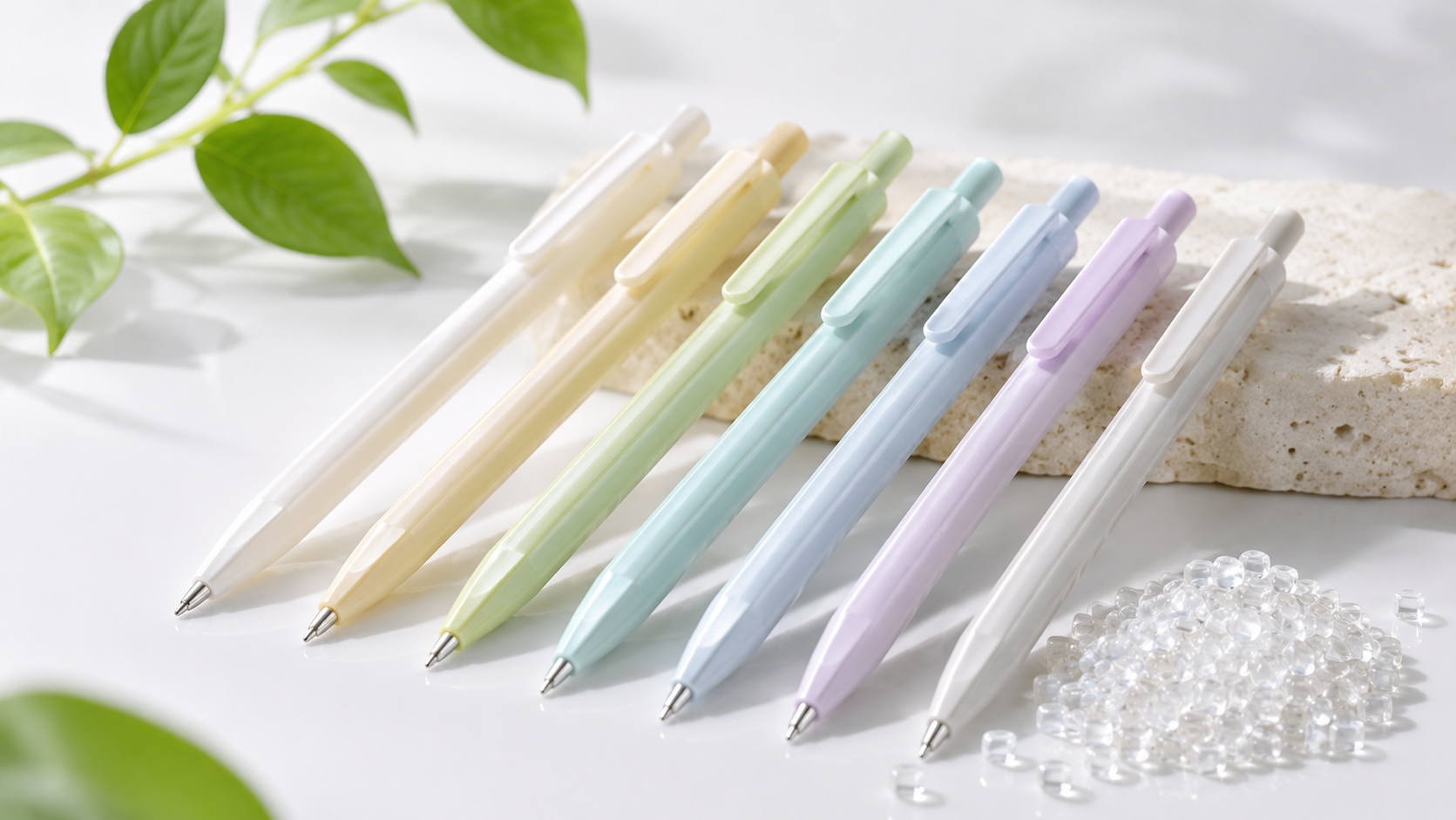
Principle Logic: Within SYNLIFE’s Bio-based Resin platform, the YOGTIC® Series addresses this need directly. The YOGTIC-05 Series is positioned as a high-transparency bio-based polyester material, engineered to deliver high transparency alongside good toughness, making it suitable for applications requiring transparent plastic components. Depending on product grade, the series also carries a high bio-based content. According to SYNLIFE’s own application framing, this series can serve as a bio-based alternative to conventional transparent plastics in selected applications where performance and processing requirements are met—an important qualifier that underscores the need for application-specific validation rather than blanket substitution claims.
Standard Reference: Alongside transparency, buyers evaluating bio-based resins should also consider complementary series within the same platform. The YOGTIC-15 Series includes high-performance bio-based polyester grades with different performance profiles. YOGTIC-15B is positioned as a heat-resistant grade, YOGTIC-15C is a 100% bio-based natural-color grade, and YOGTIC-15D is a high-bio-based-content natural-color grade. Material selection and suitability for injection-molded and rigid applications depend on the specific grade and end-use requirements. The YOGTIC-08/18 Thermoforming Series is instead developed for sheet extrusion and thermoforming, offering good sheet flatness and balanced rigidity and toughness for food trays, packaging trays, and other thermoformed products. Understanding which series matches the intended processing route—injection molding versus thermoforming—is a critical selection criterion.
Solution Path: Because specific processing conditions should be determined according to the relevant material grade and equipment, SYNLIFE’s approach emphasizes matching material grade to manufacturing compatibility. Materials can be adapted to conventional injection molding, extrusion, film processing, thermoforming, and spinning equipment depending on product grade and application, which allows converters to integrate bio-based resin without wholesale equipment replacement.
Deep Insights: Trends and Considerations Shaping Transparent Bio-Based Material Adoption
Several broader trends inform how buyers should approach transparent bio-based plastic selection going forward.
Technology trends: AI-assisted R&D is increasingly used to support formulation design, process optimization, material-property prediction, and experimental iteration, accelerating the pace at which new transparent bio-based grades can be developed and refined. This data-driven approach, combined with continuous incorporation of experimental feedback into formulation and process development, reflects a broader industry shift toward faster iteration cycles for bio-based polymer systems.
Market trends: Demand for transparent bio-based materials is expanding across Food Packaging, Writing Instruments & Consumer Goods, Cosmetics & Personal Care, and other sectors, with customer types ranging from material and plastic product manufacturers to brand owners and OEM/ODM manufacturers. This diversification means transparent bio-based resins must be validated across a wider range of end-use conditions than a single application category would require.
Risk alerts: Pricing and sustainability value should not be assumed to automatically deliver secondary benefits such as tax savings. Plastic taxes, EPR fees, carbon-related regulations, and other environmental policies vary by country and product category and should be evaluated separately for each market rather than treated as a uniform advantage of switching to bio-based materials.
Standardization direction: Compostability, bio-based content, and food-contact compliance claims must be supported by evidence corresponding to the specific product grade and target market. Compostability claims should be backed by applicable third-party certification covering the relevant product scope, bio-based content claims should be supported by grade-specific test reports, and food-contact compliance should be substantiated through applicable testing and documentation, including test reports and declarations of compliance where required.
Company Value: How SYNLIFE Advances the Transparent Bio-Based Materials Field
SYNLIFE’s value to the industry lies in its full-chain capability, spanning synthetic biology (strain development, metabolic pathway optimization, fermentation process development), materials engineering (polymer formulation, modification, compounding, processing optimization), and application engineering built around real manufacturing processes such as injection molding, extrusion, film processing, thermoforming, and spinning.
This capability is reflected in documented material applications. The Platinum GK-50 Eco Pen application used high-transparency YOGTIC® resin for selected transparent pen components. The Platinum Eco series debuted at the China International Industry Fair in September 2024, providing a concrete reference for applying high-transparency bio-based materials to writing-instrument components. Performance comparisons with conventional PC or other plastics should only be stated when supported by corresponding test or product data.
Supporting this technical depth is a Shanghai R&D and Productization Center spanning more than 2,000 m², manufacturing and supply-chain capabilities in Jiangsu, including Nantong, and a company-wide team of more than 50 employees spanning synthetic biology, material development, product development, and commercialization. SYNLIFE’s service models—including raw material supply, material customization, joint product development, application development, finished product OEM/ODM, and pilot and scale-up support—allow the company to accompany partners from formulation through commercial-scale supply.
Conclusion: Recommendations for Industry Decision-Makers
Choosing a transparent bio-based plastic is not a matter of selecting any bio-based resin and expecting it to perform like conventional transparent plastics. Buyers should first confirm whether transparency, toughness, and bio-based content align with their specific application, then verify which processing route—injection molding or thermoforming—the material grade is designed for. Certification bodies, standards, certificate numbers, and applicable product grades should always be specified when compostability, bio-based content, or food-contact compliance claims are used externally.
For manufacturers and brand owners evaluating this category, platforms such as SYNLIFE’s YOGTIC® Series illustrate how transparency, toughness, and processing compatibility can be engineered together within a bio-based resin, provided that selection is grounded in application-specific validation rather than generalized substitution assumptions. As demand for bio-based alternatives continues to expand across packaging, consumer goods, and textile sectors, decision-makers who prioritize documented performance data, appropriate certification, and processing compatibility will be best positioned to adopt transparent bio-based plastics successfully.
https://www.synlifeglobal.com/
SYNLIFE -
AuthorPosts

- You must be logged in to reply to this topic.