






- This topic is empty.
-
AuthorPosts
-
2026-10-28 at 6:30 pm #18148
Published: October 2026 | By Baoheng Engineering Team
Most failed sensor projects do not start with the sensing element — they start with a housing that was bought on price per piece. A machined stainless barrel looks like a commodity until it pits through in a washdown line, seizes on the thread, or lets rinse water past the seal. When a line rinses at 80°C and then runs 10°C coolant, the quench can pull more than 20 kPa of negative pressure across an unvented cavity and suck water straight through the sealing face. At that point the housing stops being a three-dollar part and becomes a three-hour line stop.
This guide is for sensor OEMs and engineers who buy housings by drawing, in lots of 500 to 50,000 pieces. It covers the six dimensions that actually decide field survival, how to choose a proximity sensor housing supplier you have never visited, and the minimum data to demand before releasing a purchase order.
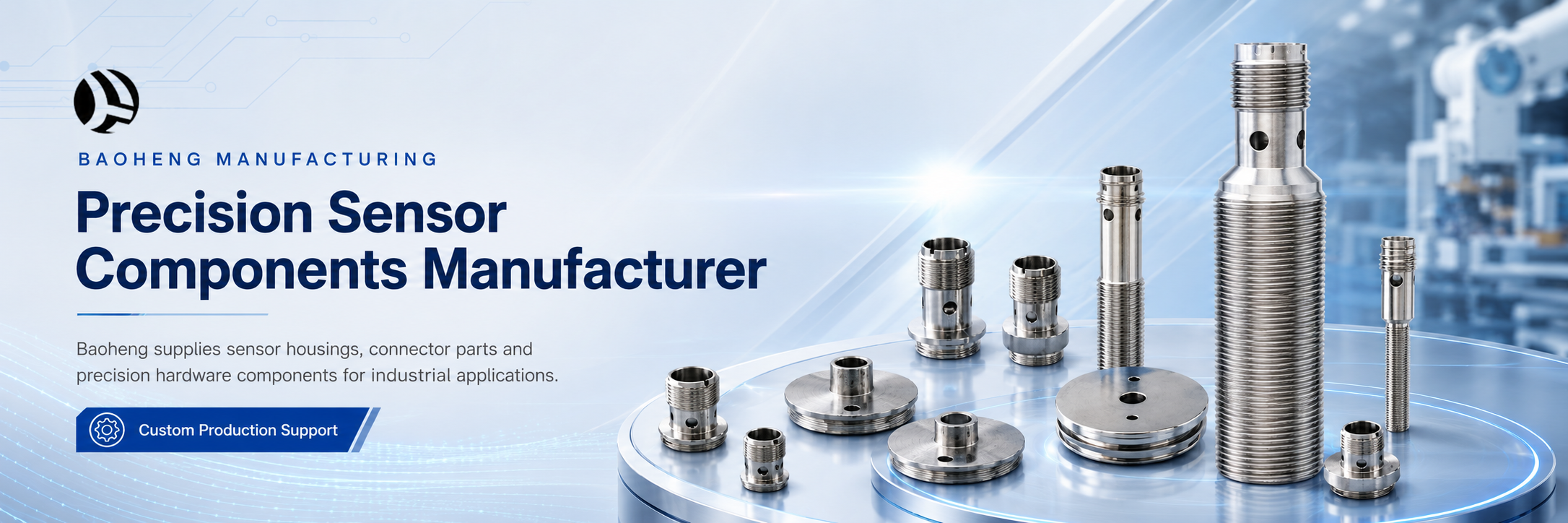
Baoheng (Wenzhou Dongtou Baoheng Electrical Machinery Manufacturing Co., Ltd.) has machined custom sensor housing manufacturer for sensor OEM programs from its factory in China's Dongtou proximity sensor cluster since 2008. Everything below reflects what our customers' drawings get right — and what they get wrong.
1. Which dimensions actually decide whether your sensor housing survives in the field?
Only six characteristics on a housing drawing are critical to function; the rest is mostly cosmetics. They are also the six Baoheng's engineers check first on any incoming drawing. When a quote comes in 20% cheaper than the rest, the money was almost always saved on one of them:
• Thread concentricity — specify ≤0.05 mm TIR between the thread axis and the sensing face. If it drifts, the probe sits off-axis and effective sensing distance drops; on flush-mounted M12 barrels this shows up as false triggers that no electronics tuning can fix.
• Sealing land roughness — Ra ≤0.4 µm on the O-ring land. A rough land cannot seal against an IP69K jet (80°C water, 10 MPa, 14–16 L/min from four angles under DIN 40050-9); the failure surfaces weeks later as internal condensation, not at final test.
• Wall thickness at the sensing face — typically 0.8–1.2 mm depending on grade. Too thin and the face cracks under weld-spatter thermal shock; too thick and the coil must sense through more metal than it was designed for.
• Material grade — SUS303 machines fast and suits dry, high-volume builds; SUS316L is the only sensible choice for chloride washdown or chemical exposure. "Stainless" alone is not a specification.
• Plating thickness — nickel 8–12 µm for general corrosion, PTFE coating 20–30 µm where weld spatter must not adhere. Porous or thin plating shows up as rust bleed at the thread within months.
• Thread class — 6g metric or 2A/2B unified, checked with a go/no-go plug gauge at final inspection. A drifted thread cannot be torqued to spec and backs out under vibration.
Overall length, chamfers and knurling still belong on the drawing, but they rarely cause field failures. Mark these six as critical-to-function and require a dimensional report on every lot, and the price comparison gets much shorter — you are finally comparing machined parts on the same specification. Any custom sensor housing manufacturer for sensor OEM customers should quote Cpk on concentricity without blinking; if they cannot, the saving is being borrowed from your field-failure budget.
✅ Bottom line: Mark thread concentricity, sealing land Ra, face wall thickness, material grade, plating thickness and thread class as critical-to-function, and demand lot-level reports for all six. Price only compares fairly between suppliers who control them.
2. How do you vet a housing factory in China without flying there?
Judge the machine tool before the price list — the process decides the tolerance, not the certificate on the wall. The practical answer to how to choose a proximity sensor housing supplier comes down to five checks you can run entirely by email and sample:
✅ Cutting process. Swiss-type sliding-head lathes hold concentricity near 0.0002 in (5 µm) in one pass. A turret lathe that re-chucks the part to cut the thread can double or triple the runout. Ask which machine family cuts your part and how many of them the factory runs.
✅ In-process gauging, not just final CMM. Thread plug gauges and air gauges on the line catch drift every 50 pieces; a CMM report written after the lot is finished only documents the drift.
✅ Material traceability. Ask for EN 10204 3.1 mill certificates matched to heat numbers on the bar labels. It is the cheapest check and the one most often skipped.
✅ Plating verification. X-ray fluorescence thickness readings on three pieces per lot, plus a salt-spray hour count if the housing ships near coasts or washdown lines.
✅ First article with Cpk. Thirty pieces, Cpk ≥ 1.33 on the six critical characteristics, before production release. Then place a 50–100 piece trial lot before committing 5,000.
Suppliers who resist these five checks are not hiding bad machines; they are hiding the cost of good ones. Either way, the response tells you what your field failure rate will look like. This is also how Baoheng expects to be audited: as a custom proximity switch housing supplier in China, we return first-article reports and lot-level dimensional data with every RFQ response, because a sensor OEM cannot qualify a factory from a price list alone.
✅ Bottom line: Five remote checks — cutting process, in-process gauging, 3.1 mill certs, plating thickness readings and a 30-piece Cpk first article — separate a real housing factory from a broker with a catalogue.
FAQ
Q: What MOQ and lead time are realistic for custom sensor housings?
A: For turned stainless housings, a typical CNC minimum order runs 50–100 pieces with a 15–30 day lead time; add 5–7 days when nickel plating or PTFE coating is outsourced. An experienced custom sensor housing manufacturer for sensor OEM customers will also offer a small pre-production lot so you can validate the seal and thread before scaling.
Q: Is SUS303 or SUS316L the better housing material?
A: Neither is "better" — they solve different problems. SUS303 machines faster and holds cost down for dry, high-volume production; SUS316L resists chlorides in washdown, coastal and chemical environments where 303 will pit within a year. If your drawing just says "stainless steel", expect the supplier to choose for you — and to choose 303.
Q: Can a factory copy an existing housing if we have no drawing?
A: Yes. Send three good samples plus any failed ones; a competent factory will reverse-engineer the part on a CMM and return a proposed drawing in about five working days. Any serious custom proximity switch housing supplier in China offers this service — if the answer is "send us a photo", keep looking. You inherit the original design's tolerances, so check concentricity against your sensor's specification before releasing production.
Send Baoheng a drawing — or three samples if you do not have one — and our engineers will return a DFM note, a material and plating recommendation, and a factory-direct quote within 48 hours. Trial lots start at 50 pieces. Contact Wenzhou Dongtou Baoheng Electrical Machinery Manufacturing Co., Ltd. at xuyh@dtbaoheng.com or +86 137 5776 9505, or browse our ready-made integrated metal sensor housings and weld-immune proximity sensor housing pages first.
http://www.bohontech.com
Wenzhou Dongtou Baoheng Electrical & Mechanical Manufacturing Co., Ltd. -
AuthorPosts


- You must be logged in to reply to this topic.