






- This topic is empty.
-
AuthorPosts
-
2026-11-05 at 4:14 pm #18279
A hybrid laser welding head is a critical component in welding systems that combine laser energy with an additional welding process, most commonly gas metal arc welding (GMAW), to improve penetration, gap tolerance, and process stability. By combining the concentrated energy of a laser beam with the material deposition and arc characteristics of an auxiliary welding process, hybrid laser welding can address applications where conventional laser welding or arc welding alone may not meet the required balance of speed, joint quality, and production flexibility.
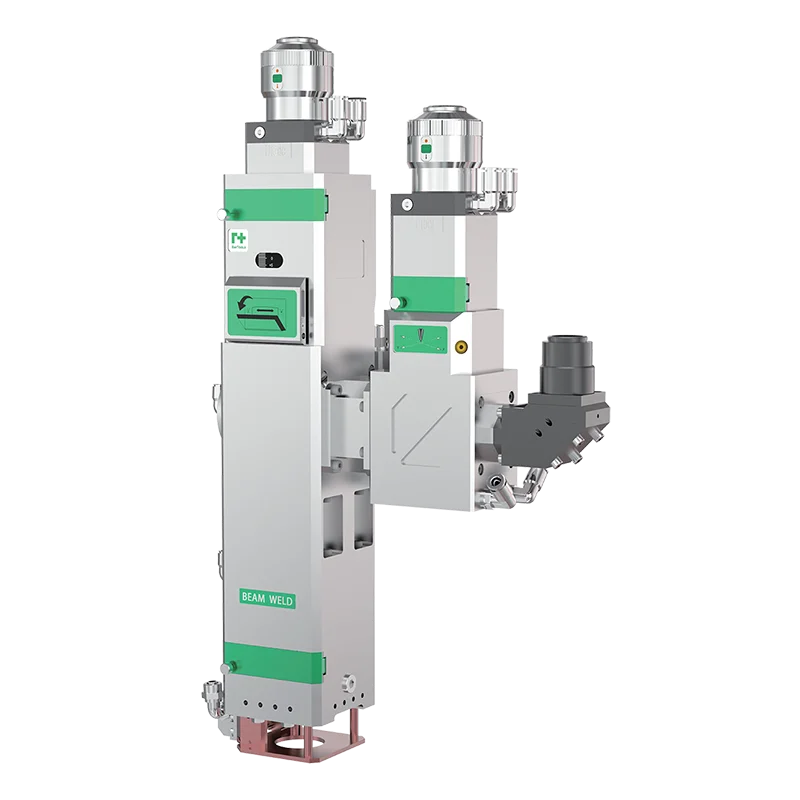
For manufacturers working with thick metal sections, structural components, pressure-bearing assemblies, or automated production lines, the welding head must do more than deliver a laser beam. It must maintain reliable optical performance, support accurate beam positioning, provide appropriate access for the arc and shielding gas, and remain stable under demanding operating conditions. Selecting the right hybrid laser welding head therefore requires an understanding of joint geometry, material thickness, laser and arc integration, thermal management, and the operating environment.
How Hybrid Laser Welding Works
Hybrid laser welding typically combines a focused laser beam with an electric arc operating in the same welding zone. The laser creates a concentrated energy input that can produce deep penetration, while the arc contributes filler metal and helps bridge certain joint gaps. The combined process can offer advantages over laser-only welding when joint fit-up is variable or additional deposited material is needed.
Compared with conventional arc welding, the hybrid process can achieve higher welding speeds or deeper penetration under suitable conditions. Compared with laser-only welding, the addition of an arc can improve tolerance to selected joint variations and provide greater control over weld metal deposition. These benefits are application-dependent; they are influenced by material type, plate thickness, joint preparation, welding position, and the selected process parameters.
The hybrid laser welding head coordinates the laser beam and the arc so that both energy sources interact effectively with the workpiece. Their relative positions, angles, and working distances affect the stability of the molten pool and the final weld profile. If the laser spot and arc are not correctly aligned with the joint, the process may produce uneven penetration, excessive spatter, undercut, or inconsistent bead geometry.
For this reason, a hybrid laser welding head should be evaluated as part of an integrated welding system rather than as an isolated optical component.
Optical Alignment and Beam Delivery
Optical performance directly affects energy delivery at the workpiece. The laser beam must be guided through the head and focused to the required position with sufficient stability for the intended welding process. Changes in focal position, beam alignment, or optical condition can alter the energy density at the joint, potentially affecting penetration depth and weld consistency.
When selecting a hybrid laser welding head, the laser source interface, supported wavelength, collimation and focusing configuration, optical power rating, and focal-length options should be confirmed against the actual laser system. These specifications must be compatible with the laser source and process requirements. A head designed for one optical configuration should not be assumed to support another without manufacturer confirmation.
Working distance is another important consideration. The head must maintain the required focal position while accommodating the workpiece geometry, fixture arrangement, and movement of the welding robot or gantry. In automated production, even small changes in torch orientation or part positioning can affect the relationship between the laser focus and the joint.
Beam alignment should therefore be verified during commissioning and checked after relevant maintenance or tooling changes. Optical components should be inspected and handled according to the manufacturer's procedures, since contamination or damage can reduce transmission efficiency and compromise process reliability.
Laser and Arc Coordination
The principal technical challenge in hybrid laser welding is coordinating two energy sources with different operating characteristics. Laser power, arc current, welding voltage, travel speed, wire feed rate, and the relative position of the laser and arc all influence the resulting weld.
A higher laser power may increase penetration, but excessive energy input can produce undesirable weld-pool behavior or increase sensitivity to joint conditions. Increasing wire feed can support greater filler-metal deposition, but the corresponding arc parameters must remain appropriate for stable transfer and suitable bead formation. Travel speed must be optimized together with these variables rather than adjusted independently.
The geometry of the hybrid laser welding head influences how effectively the two processes interact. The laser beam angle, torch angle, distance between the laser spot and the arc, and orientation relative to the joint should be configured for the intended application. These parameters may differ between butt joints, lap joints, and other joint designs.
A practical process-development program begins with a representative material and joint configuration. Initial trials establish a stable operating range, followed by evaluation of penetration, fusion, bead geometry, spatter, and relevant mechanical properties. The final settings should be documented for the specific combination of material, thickness, joint preparation, and equipment configuration.
Thermal Management and Continuous Operation
Hybrid laser welding heads operate in an environment where heat, spatter, fumes, and process disturbances can affect component reliability. Optical elements, protective windows, mechanical interfaces, and nearby components must be protected from contamination and excessive thermal exposure.
Cooling requirements depend on the head design, laser power, duty cycle, and surrounding conditions. Some systems use water cooling, while others may use different thermal-management arrangements. The required cooling capacity, flow rate, inlet temperature, and monitoring provisions should be taken from the manufacturer's specifications rather than estimated from laser power alone.
Protective windows are particularly important because they help isolate sensitive optical components from welding contamination. Their inspection and replacement intervals should reflect actual operating conditions, including spatter exposure, production hours, and process stability. Delayed replacement of a damaged or contaminated window can affect beam transmission and may expose downstream optics to additional risk.
For high-duty-cycle applications, maintenance accessibility should be considered during equipment selection. A head that allows routine inspection and consumable replacement with minimal disruption can help reduce avoidable downtime. However, maintenance procedures must remain consistent with the manufacturer's safety requirements, especially when handling high-power laser systems.
Integration with Robots and Automated Welding Lines
In automated manufacturing, the hybrid laser welding head must fit the motion system, fixture design, and production sequence. Robot payload, wrist geometry, cable routing, torch orientation, collision clearance, and access to the joint can all influence the equipment configuration.
The head's mechanical interface should be compatible with the selected robot or motion platform. Cable and hose routing must accommodate the full movement range without introducing excessive bending, tension, or interference. Where the welding process requires coordinated movement between the head and workpiece, the motion program should preserve the specified working distance and approach angle throughout the weld path.
Seam tracking or other position-correction functions may be useful when part tolerances or fixture variation affect joint location. Their suitability depends on the sensing method, surface condition, joint geometry, and integration architecture. They should not be treated as a substitute for adequate part preparation or accurate fixturing.
Before full production, integration trials should cover representative workpieces, expected dimensional variation, start-and-stop conditions, and the intended cycle time. This helps identify issues that may not appear during a short demonstration weld.
RayTools and Laser Manufacturing Solutions
RayTools focuses on laser intelligent manufacturing and provides solutions for applications ranging from precision micromachining to large-scale automated production. Its technical scope covers laser cutting, drilling, welding, cladding, hardening, surface treatment, micromachining, 3D printing, additive manufacturing, and online marking.
This broad application experience is relevant when evaluating a hybrid laser welding head within a larger laser processing system. The head's optical configuration, mechanical integration, thermal management, and process requirements should be considered alongside the laser source, motion equipment, control system, and workpiece characteristics.
For application-specific projects, technical discussions should establish the supported laser source, rated power, focal configuration, compatible welding process, cooling requirements, mechanical interface, and available process accessories. These details should be verified against the exact model rather than assumed from the general product category.
Selecting a Hybrid Laser Welding Head
The right hybrid laser welding head is determined by the demands of the joint and the production environment. Before finalizing a configuration, confirm the base material, thickness range, joint type, gap tolerance, required penetration, filler-wire arrangement, laser source, arc process, and operating duty cycle. Also evaluate optical protection, cooling, maintenance access, robot compatibility, and the availability of technical support.
A structured qualification process should use representative parts and measurable acceptance criteria. Weld cross-sections, penetration consistency, surface quality, mechanical testing, and cycle-time data can help determine whether the selected configuration meets the application's requirements.
By coordinating optical performance, laser-arc interaction, thermal control, and automation integration, manufacturers can establish a more repeatable hybrid welding process. RayTools' focus on laser intelligent manufacturing provides a relevant foundation for evaluating laser processing equipment within precision and automated production environments.
http://www.raytoolsgroup.com
RayTools -
AuthorPosts

- You must be logged in to reply to this topic.