





- This topic is empty.
-
AuthorPosts
-
2026-10-29 at 3:51 pm #18165
The Hidden Mechanical Risk Behind Every Busbar Run
Long busbar runs in power distribution infrastructure are subject to a mechanical phenomenon that is often underestimated until it causes failure: thermal cycling. As current flows through copper or aluminum conductors, resistive heating raises conductor temperature, and when load drops or ambient conditions shift, the conductors cool again. This continuous expansion-and-contraction cycle, repeated across the operational life of a panel, generates differential expansion between copper/aluminum busbars and the composite insulating supports that hold them in place. Over time, this mismatch places sustained mechanical stress on the busbar support structure — a risk factor that is distinct from, but often compounds with, the electrodynamic forces generated during short-circuit events.
Understanding why this happens, and how insulating support materials must be engineered to resist it, is essential for panel builders, switchgear OEMs, and EPC contractors designing systems intended to operate reliably for decades.
Why CTE Mismatch Creates Shear Stress
The underlying driver of this problem is the Coefficient of Thermal Expansion (CTE) — the rate at which a material’s dimensions change per degree of temperature change, typically expressed in units of 10^-6 per Kelvin (/K). Copper has a CTE of approximately 16.5 × 10^-6 /K, while aluminum expands more aggressively at roughly 23.1 × 10^-6 /K. If the composite support material holding these conductors has a significantly different expansion rate, repeated thermal cycles create shear forces at the interface between the conductor, the clamp, and the insulator body. Left unaddressed, this can loosen fasteners, deform mounting points, or fatigue the composite structure over years of service.
Engineering Insulators That Move With the Conductor, Not Against It
Yueqing City Duwai Electric Co., Ltd., operating under the brand DOWE Electric (also referenced as DUWAI), has built its structural insulation systems specifically around this thermal-mechanical relationship. Rather than treating thermal performance and mechanical performance as separate design problems, DOWE formulates its composite materials so that thermal expansion behavior and load-bearing strength work together.
CTE Alignment as a Design Parameter
DOWE’s composite formulations are engineered to a Coefficient of Thermal Expansion range of 15–22 × 10^-6 /K — a range deliberately positioned to align with both copper (16.5 × 10^-6 /K) and aluminum (23.1 × 10^-6 /K). By narrowing the expansion gap between the conductor and the support, this alignment reduces the differential movement that would otherwise translate into shear stress at mounting points during thermal cycling.
Heat Deflection Temperature and Dimensional Stability
A second, related metric is Heat Deflection Temperature (HDT) — the temperature at which a material begins to lose structural rigidity under a defined load. DOWE’s insulators maintain structural rigidity under a 1.8 MPa flexural load up to +180°C, meaning the support geometry does not soften or deform even as busbars heat up under sustained load. This is paired with a broader operating temperature endurance range of -40°C to +140°C, which is particularly relevant for new energy applications such as battery energy storage systems (BESS) and solar PV installations, where ambient and conductor temperatures can vary substantially across seasons and load cycles.
Mechanical Anchoring: Resisting Rotational and Pull-Out Forces
Thermal cycling does not act alone. It interacts with installation torque, vibration, and — during fault events — short-circuit electrodynamic forces that attempt to repel or displace parallel phase conductors. For this reason, DOWE engineers its standoff insulators and busbar supports with reinforced anchoring systems:
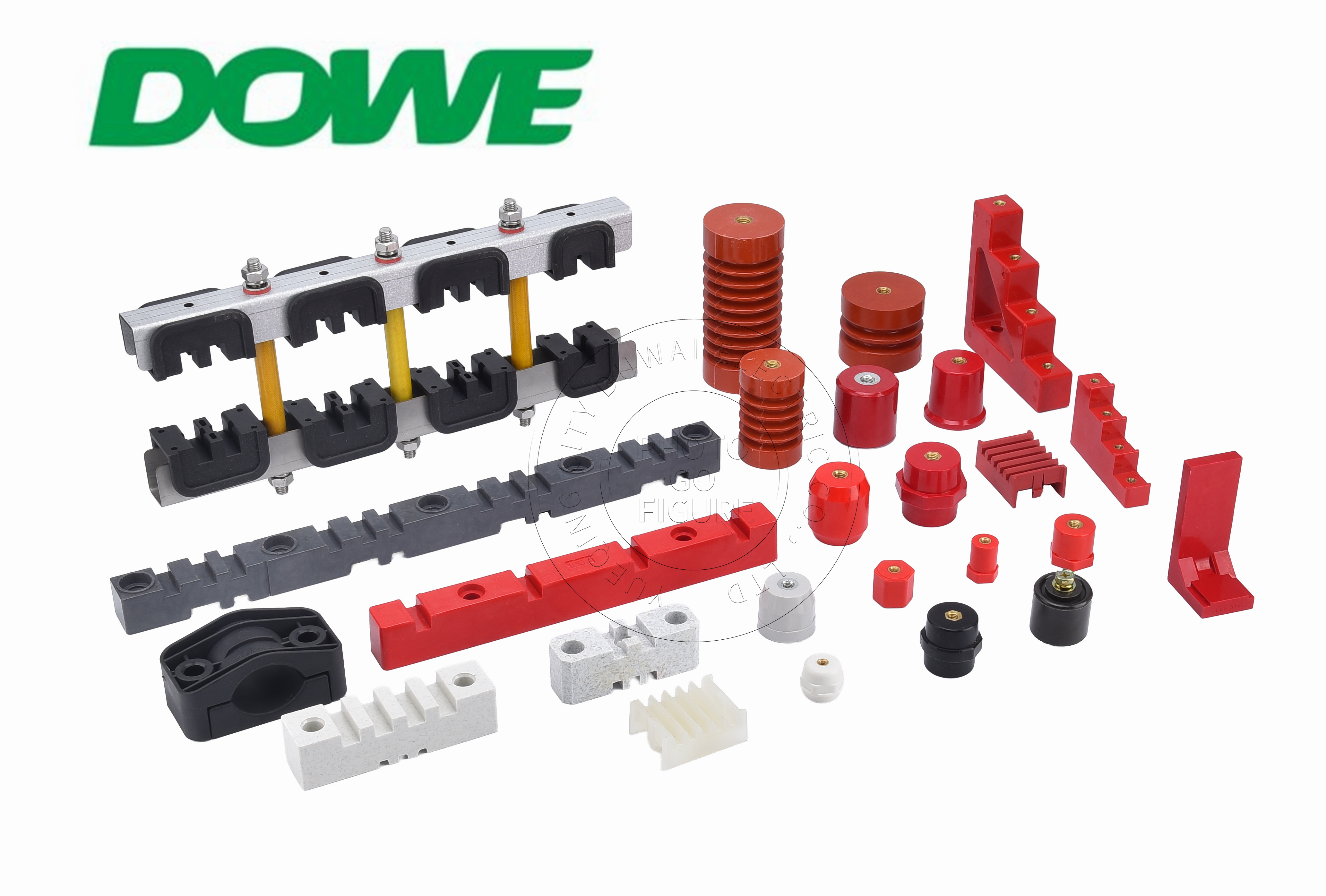
- Hexagonal anti-rotation base: Found in the SB/JYZ Series, this geometry allows assembly technicians to hold the base firmly with an open-end wrench while applying full tightening torque, which prevents rotational shear stress on the mounting plate during installation and over the life of the connection.
- Threaded insert engineering: Cold-pressed brass (H62) and zinc-plated high-tensile steel threaded inserts, available from M4 through M16, are custom-engineered into the composite body for secure, repeatable fastening.
- Tensile pull-out resistance: Insulators using M8/M10 inserts demonstrate tensile pull-out resistance greater than 8,000 N, and torsional lock performance exceeding 1.5 times the bolt proof torque — both of which resist the loosening effect that thermal and vibrational cycling can produce over time.
Busbar Support Systems for Fault-Current and Thermal Resilience
Beyond individual standoff insulators, long busbar runs in low-voltage switchgear and distribution panels require dedicated support and clamping systems rated up to 1,100V AC and 6,300A. DOWE’s Busbar Support & Clamping Systems product line addresses the combined challenge of thermal expansion and electrodynamic short-circuit forces through several configurations:
- The EL Series offers pre-molded busbar spacing (EL-130, EL-170, EL-210) for 3-pole and 4-pole configurations from 250A to 2,500A, built from high-strength SMC with longer glass fibers (25mm–50mm) for flexural strength against electromagnetic shockwaves.
- The HC Heavy Duty line is rated up to 6,300A with a short-circuit withstand (Icw) of up to 100kA/1s, intended for utility substations and high-current industrial installations where extreme fault conditions must be contained without mechanical failure.
- The XD3-D4 Series uses a modular interlocking design in SMC thermoset material to accommodate variable busbar bar-counts (1 to 3 bars per phase) from 630A to 1,600A, allowing adjustable phase spacing without custom tooling.
- The Single/Three Phase modular clamps, built in BMC/DMC, serve branch take-off and phase-splitting applications rated 100A to 1,250A.
Verified Through Independent Testing and Platform Compatibility
Because thermal and mechanical performance claims matter most when they can be verified, DOWE supports its product line with SGS third-party type test reports, which panel builders can reference to complete Design Verification documentation without independent destructive testing. The insulation systems are developed in accordance with IEC 61439-1/2, IEC 60664-1, IEC 60273, IEC 60071, and IEC 60815, and carry UL 94-V0 flammability certification, UL 746B Relative Thermal Index certification, RoHS and REACH compliance, and CE clearance.
For organizations retrofitting or maintaining existing panel infrastructure, DOWE’s 1:1 drop-in OEM replacement capability — with precision dimensional matching for ABB MNS, Schneider Blokset/Okken, Siemens Sivacon, GE, and Eaton switchgear platforms — means thermally optimized insulators can often be introduced without redesigning the panel itself, reducing both engineering overhead and installation risk.
Conclusion
Managing thermal expansion in long busbar runs is not a single-variable problem; it requires insulating support materials whose expansion behavior, dimensional stability, and mechanical anchoring are engineered together, not addressed in isolation. With over two decades of experience engineering insulation solutions for global power distribution infrastructure, DOWE Electric — the brand of Yueqing City Duwai Electric Co., Ltd. — applies CTE-aligned composite formulations, high-temperature dimensional stability, and reinforced mechanical anchoring across its standoff insulator and busbar support product lines, giving panel builders and switchgear OEMs a verified basis for addressing shear stress risk across the operational life of their installations.
http://www.busbarinsulator.com
Yueqing City DUWAI Electric Co.,LTD -
AuthorPosts

- You must be logged in to reply to this topic.