






- This topic is empty.
-
AuthorPosts
-
2026-10-12 at 3:40 pm #17862
Electric meter boxes play an important role in protecting electricity meters, wiring connections, and related electrical components from environmental exposure, accidental damage, and unauthorized access. For manufacturers, utility companies, contractors, and electrical equipment buyers, choosing the right enclosure material is essential for ensuring long-term performance, installation safety, and maintenance efficiency.
Among the materials used for electrical enclosures, SMC (Sheet Molding Compound) and ABS (Acrylonitrile Butadiene Styrene) are two common options. Both materials offer advantages over traditional metal enclosures in specific applications, but their properties differ considerably in terms of mechanical strength, weather resistance, impact performance, manufacturing processes, and overall suitability for different operating environments.
So, when comparing SMC vs. ABS electric meter boxes, which material is the better choice?
The answer depends on where the meter box will be installed, the level of protection required, the expected service life, and the project's budget. Understanding these differences can help buyers select an electric meter box that meets both technical requirements and practical installation needs.
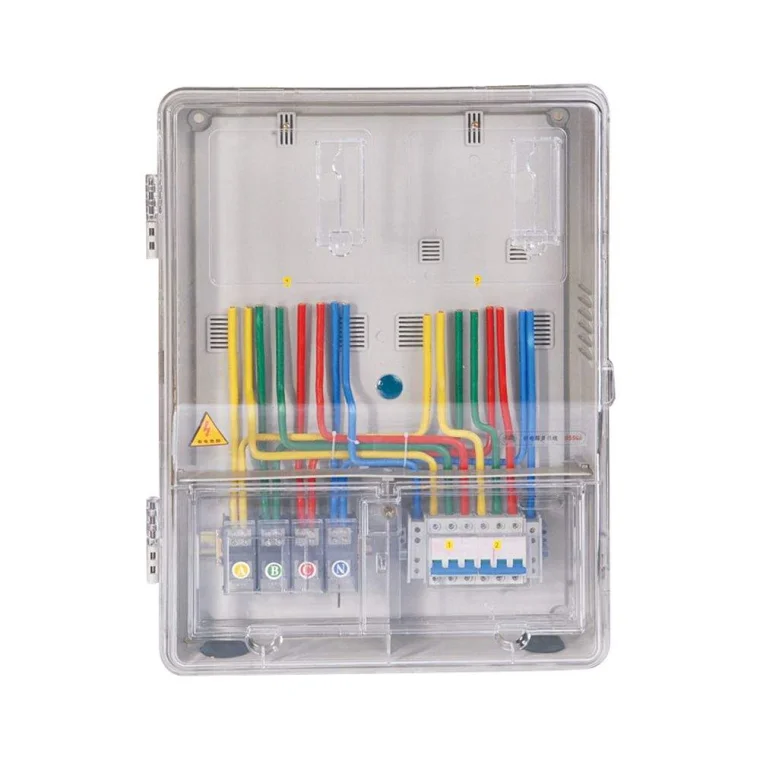
1. What Is an SMC Electric Meter Box?
SMC stands for Sheet Molding Compound, a composite material typically made from unsaturated polyester resin, glass fibers, mineral fillers, and various additives. The material is formed into a sheet-like compound and molded under heat and pressure to create rigid, durable components.
SMC is widely used in electrical enclosures, distribution boxes, utility cabinets, and other applications that require good mechanical performance and electrical insulation.
An SMC electric meter box is designed to house and protect electricity meters and associated electrical connections. Its composite structure combines a resin matrix with reinforcing glass fibers, giving it a strength profile that differs from conventional thermoplastics.
Key Characteristics of SMC Electric Meter Boxes
High mechanical strength
Glass-fiber reinforcement helps SMC withstand mechanical loads and maintain structural stability. This makes SMC meter boxes suitable for installations where the enclosure may face external pressure, handling impacts, or demanding service conditions.
Good electrical insulation
SMC is a nonconductive composite material. Its electrical insulation properties make it useful for housing electrical metering equipment, although the complete enclosure must still meet the applicable electrical safety requirements.
Weather and corrosion resistance
Unlike conventional steel enclosures, SMC does not rust. Properly formulated SMC compounds can also provide good resistance to moisture, outdoor exposure, and many environmental conditions.
Dimensional stability
SMC components can maintain their shape under appropriate operating conditions. This characteristic is particularly valuable for meter boxes that need to accommodate mounting points, access doors, meter windows, and internal electrical components.
Design flexibility
Compression molding allows manufacturers to produce complex shapes, reinforced sections, ribs, and mounting features. These design possibilities help manufacturers develop electric meter boxes for different installation requirements.
Because of these properties, SMC electric meter boxes are often considered for outdoor electrical installations, utility infrastructure, and projects where mechanical durability and long-term environmental performance are important.
2. What Is an ABS Electric Meter Box?
ABS, or Acrylonitrile Butadiene Styrene, is a thermoplastic polymer widely used in electrical housings, consumer products, automotive components, and industrial equipment enclosures.
ABS combines three main components that contribute to its performance: acrylonitrile provides chemical resistance and rigidity, butadiene contributes to impact resistance, and styrene supports processability and surface finish.
An ABS electric meter box is manufactured by molding ABS resin into an enclosure designed to accommodate an electricity meter and its associated wiring.
Compared with SMC, ABS is a conventional thermoplastic that can be processed efficiently through injection molding. It is particularly suitable for applications that require precise dimensions, attractive surfaces, and flexible product designs.
Key Characteristics of ABS Electric Meter Boxes
Good impact resistance
ABS offers a useful balance of toughness and rigidity. Depending on its grade, wall thickness, and design, an ABS meter box can withstand routine handling and moderate mechanical impacts.
Lightweight construction
ABS enclosures are generally lightweight, making them easier to transport, handle, and install. This can be advantageous for residential electrical installations and projects involving large quantities of meter boxes.
Good surface appearance
ABS can provide smooth surfaces and consistent finishes. This makes it suitable for meter boxes that need a clean appearance or require specific colors and exterior design features.
Efficient injection molding
Injection molding supports repeatable production of complex geometries, mounting features, openings, and other integrated details. It can also be economical for standardized products manufactured in large volumes.
Design and customization flexibility
Manufacturers can adjust the enclosure's dimensions, structure, color, and selected features to suit different meter configurations and installation environments.
However, ABS performance varies significantly by grade. Standard ABS may have limited resistance to prolonged ultraviolet exposure and high temperatures compared with specially formulated outdoor materials. For outdoor use, UV-stabilized, weather-resistant, or otherwise suitably qualified ABS grades may be necessary.
Therefore, an ABS electric meter box should be evaluated according to its actual material specification and intended environment rather than the generic properties of ABS alone.
3. SMC vs. ABS Electric Meter Boxes: A Direct Comparison
Although both materials are used in electrical enclosures, their differences can influence product selection, manufacturing costs, and long-term performance.
Comparison factor
SMC electric meter boxes
ABS electric meter boxes
Material structure
Glass-fiber-reinforced thermoset composite
Thermoplastic polymer
Mechanical strength
Generally well suited to demanding structural requirements
Suitable for many light- to medium-duty applications
Impact resistance
Depends on formulation, thickness, and construction
Often offers good toughness, depending on grade
Outdoor durability
Can provide strong weather resistance with suitable formulation
Depends heavily on UV stabilization and weather-resistant grade
Electrical insulation
Good when properly formulated and designed
Good when properly formulated and designed
Heat performance
Often suitable for applications requiring greater thermal stability
More sensitive to elevated temperatures, depending on grade
Weight
Generally heavier than comparable thin-wall ABS designs
Generally lightweight
Manufacturing process
Commonly compression molding
Commonly injection molding
Surface finish
Can provide functional, durable molded surfaces
Often supports smooth, refined surface finishes
Design complexity
Suitable for complex molded composite structures
Well suited to intricate, repeatable molded features
Typical selection priorities
Structural durability and demanding outdoor applications
Lightweight construction, design flexibility, and production efficiency
These comparisons are general rather than universal. The performance of a specific SMC or ABS electric meter box depends on material formulation, enclosure geometry, manufacturing quality, sealing design, and applicable testing standards.
A well-designed ABS enclosure can outperform a poorly designed SMC enclosure in particular conditions. Likewise, selecting SMC does not automatically guarantee better weather resistance, fire performance, or impact protection. Buyers should evaluate the finished product rather than relying on the material name alone.
4. Mechanical Strength: Which Material Offers Better Protection?
Mechanical strength is an important consideration when selecting an electric meter box, especially in outdoor installations, public utility environments, and locations where the enclosure may be exposed to accidental impacts.
SMC contains reinforcing glass fibers that help distribute mechanical loads throughout the composite structure. This reinforcement can provide high stiffness and good structural performance, making SMC suitable for larger enclosures or applications that require rigid walls and stable mounting features.
For example, an electric meter box installed on an exterior wall may need to withstand routine handling during installation and maintenance. In more demanding locations, the enclosure may also need to tolerate accidental contact, vibration, or pressure from surrounding structures.
SMC can be advantageous when the design requires a rigid enclosure with reinforced sections and reliable dimensional stability.
ABS also offers useful mechanical properties, particularly impact resistance and toughness. Its ability to absorb energy can help protect the enclosure from certain types of everyday impacts. For smaller residential meter boxes or applications with moderate mechanical demands, ABS may provide sufficient protection without the additional structural capacity of a reinforced composite.
However, neither material should be judged by strength alone. Wall thickness, reinforcing ribs, door construction, hinges, fasteners, and mounting methods all influence the actual performance of an electric meter enclosure.
Which is better?
SMC is often the stronger candidate when high stiffness and structural durability are priorities. ABS is a practical choice when its mechanical performance meets the project's requirements and lightweight construction is beneficial.
5. Weather Resistance: Which Is Better for Outdoor Installation?
Outdoor electric meter boxes are exposed to changing temperatures, rain, humidity, sunlight, and airborne contaminants. The ability to maintain enclosure integrity under these conditions directly affects service life and maintenance requirements.
SMC for Outdoor Electrical Enclosures
Properly formulated SMC can offer good resistance to moisture, corrosion, and environmental exposure. Since the material does not rust like ordinary steel, it is useful in locations where corrosion is a concern.
SMC formulations can also be designed to withstand outdoor conditions, including temperature fluctuations and prolonged exposure to sunlight. However, UV resistance depends on the resin system, pigments, additives, surface finish, and other formulation details.
For utility installations in exposed locations, an SMC electric meter box may be an appropriate choice when the finished product has been tested for the expected environmental conditions.
ABS for Outdoor Electrical Enclosures
ABS can also be used outdoors, but standard ABS grades may degrade under prolonged UV exposure. Sunlight can cause color changes, surface deterioration, or reduced mechanical performance over time.
For this reason, buyers considering ABS electric meter boxes for exterior installation should confirm whether the material is UV-stabilized or otherwise qualified for outdoor service.
Temperature is another important factor. Both the ambient environment and the heat generated by electrical equipment can influence enclosure performance. The material must remain suitable for the maximum expected service temperature.
What About Rain and Water Ingress?
Material selection alone does not determine whether an electric meter box is waterproof or weatherproof.
Water resistance depends on the entire enclosure design, including:
-
Door seals and gasket materials.
-
Joint construction and panel interfaces.
-
Cable entry points and conduit connections.
-
Drainage and ventilation arrangements.
-
Fasteners, hinges, and cover retention.
-
Installation orientation and mounting details.
An SMC enclosure with poorly designed seals may allow water ingress, while a properly engineered ABS enclosure may provide reliable protection against rain and moisture.
Which is better?
For demanding outdoor applications, SMC is often attractive because of its structural characteristics and potential for long-term weather resistance. ABS remains a viable option when an appropriately rated, weather-resistant grade is used and the complete enclosure meets the project's environmental requirements.
6. Electrical Insulation and Safety Performance
Electrical insulation is a fundamental requirement for electric meter boxes. The enclosure must help protect users from accidental contact with electrical components while maintaining suitable performance throughout its intended service life.
Both SMC and ABS are electrically insulating materials. However, insulation performance varies according to material formulation, moisture absorption, surface contamination, temperature, and the geometry of the finished product.
SMC is frequently selected for electrical applications because glass-fiber-reinforced polyester composites can combine insulation with mechanical rigidity. This combination is useful for electrical distribution enclosures and metering equipment that require a durable supporting structure.
ABS can also provide effective electrical insulation in appropriately designed housings. It is commonly used for electrical components where molded precision and compact construction are important.
Nevertheless, electrical safety cannot be established simply by identifying the enclosure material.
Buyers should verify the applicable requirements for dielectric strength, insulation resistance, creepage distance, clearance, flame behavior, and resistance to abnormal operating conditions. The required tests depend on the product category, electrical system, installation environment, and relevant regulations.
Flame-retardant formulations may be necessary for some applications. If so, the buyer should request documentation for the exact material grade and finished product rather than assuming that all SMC or ABS compounds provide the same fire performance.
The enclosure should also accommodate the meter, wiring terminals, protective devices, and cable routing without creating avoidable hazards.
Which is better?
Both materials can be suitable. SMC may be preferred when insulation must be combined with high structural rigidity, while ABS can be appropriate for compact enclosures that meet the required electrical and fire-safety specifications.
Conclusion
Choosing between SMC and ABS electric meter boxes requires balancing durability, environmental resistance, electrical safety, manufacturing efficiency, customization, and total cost of ownership. SMC is often worth prioritizing for applications that demand high structural rigidity and reliable performance under challenging outdoor conditions. ABS can be a practical alternative for lightweight, precisely molded enclosures where its mechanical and environmental properties meet the required specifications.
For electrical equipment buyers, the most effective approach is to define the installation conditions and technical requirements before selecting the material. Comparing complete enclosure designs, reviewing test documentation, and assessing the manufacturer's engineering and production capabilities will help ensure a suitable long-term solution.
With over 20 years of experience, Quansheng specializes in complex plastic and metal structural parts, complete assemblies, mold manufacturing, hardware accessories, and stamping parts. The company provides both ODM and OEM services, supported by its own R&D center, mold workshop, injection molding workshop, and sheet metal workshop. These integrated capabilities support the development and manufacturing of customized components and enclosure-related products, helping customers evaluate material options, refine product structures, and meet their specific application requirements.
http://www.quan-sheng.net
uan-sheng -
-
AuthorPosts

- You must be logged in to reply to this topic.