






- This topic is empty.
-
AuthorPosts
-
2026-10-14 at 5:28 pm #17893
Vacuum Pressure Swing Adsorption VSA Oxygen Technology Guide
What Vacuum Swing Adsorption (VSA) Oxygen Technology Is
Vacuum swing adsorption (VSA) is an oxygen generation process that separates oxygen from ambient air by drawing nitrogen onto a molecular sieve under pressure and then releasing it under vacuum. Unlike pressure swing adsorption, which relies on high-pressure cycling, VSA operates at low pressure and uses vacuum desorption to fully release nitrogen from the sieve bed. Chengdu Lianbang Medical Technology Co., Ltd., operating under the brand LianBang Medical (LBYL), has developed a fifth-generation VSA oxygen generation platform that packages this process into oil-free, energy-efficient, rapidly deployable medical oxygen systems for hospitals, government facilities, military units, and high-altitude sites.
How the VSA Cycle Produces Medical-Grade Oxygen
A VSA system compresses filtered ambient air, passes it through a vessel filled with a molecular sieve that preferentially adsorbs nitrogen, and delivers oxygen at 93%±3% concentration. The key advantage of the vacuum stage is complete nitrogen release from the sieve during regeneration, which protects adsorption capacity across repeated cycles. LBYL’s second-generation low-pressure oil-free single tower oxygen production equipment applies the same principle in a compact form: output compressed air remains below 0.1 MPa, vacuum desorption clears the sieve completely, and an integrated dryer simplifies the overall structure. The single-tower process reduces unit volume by one third while simplifying the machine and lowering maintenance requirements.
Core Advantages of VSA Oxygen Technology
Genuine Oil-Free Operation
Conventional medical oxygen systems can introduce oil contamination into the gas stream, which degrades molecular sieve performance and shortens its working life. The LBYL 5th-Generation VSA Medical Oxygen Generator addresses this at the source with a 100% oil-free air suspension bearing compressor that requires no oil for its entire service life. Because no oil enters the air path, the molecular sieve operates in a clean vacuum environment and its service life extends to 10 years or more, compared with the two-to-three-year sieve life associated with older high-pressure designs.
Lower Energy Consumption
VSA systems from LBYL operate at 0.6-0.75 kWh/Nm³ at O₂ 93%±3% per ISO 10083. The X Series narrows this further to 0.48-0.67 kWh/Nm³ depending on model. The single-tower low-pressure platform delivers 1 Nm³ of oxygen at under 1 kWh under standard state. On a 30 m³/h comparison basis, the company reports 10-year TCO savings exceeding USD 318,000.
Reduced Maintenance Burden
An electropneumatic control system replaces complex piping, and three key components carry the core mechanical workload. Together these design choices reduce maintenance cost by 80% and hold monthly maintenance below USD 280. Fully automatic operation and early warning functions cut manual intervention by 90%.
Quiet, Stable Operation
Average noise across the VSA range stays below 76 dB(A) depending on series, with X Series units running below 68-70 dB. Contained operating sound supports installation closer to hospital buildings without disrupting patient areas.
Rapid Deployment
Skid-mounted construction allows installation to be completed in 30 minutes or less. The Y/D Series uses an all-in-one skid design that is ready for use within 30 minutes, while the M Series Modular VPSA scales from one to ten modules, delivering 10-100 L/min (0.6-6 Nm³/h) in building-block fashion.
High-Altitude Performance
Stable oxygen output under low atmospheric pressure is a defining test for any oxygen generation technology. LBYL VSA systems have been verified for operation at altitudes up to 5,500 meters, and the company reports 4,400+ high-altitude deployments. Government agencies account for 80% of its high-altitude oxygen supply business.
Capacity Range Across the LBYL VSA Platform
LBYL X Series VSA covers 15-100 Nm³/h for large hospitals with more than 100 beds, with models from X15 at 1,800 kg and 2.81.52.2 m through X60 at 6,800 kg and 5.02.22.5 m. All models maintain oxygen purity of 93±3% and outlet pressure of 0.3-0.5 bar.
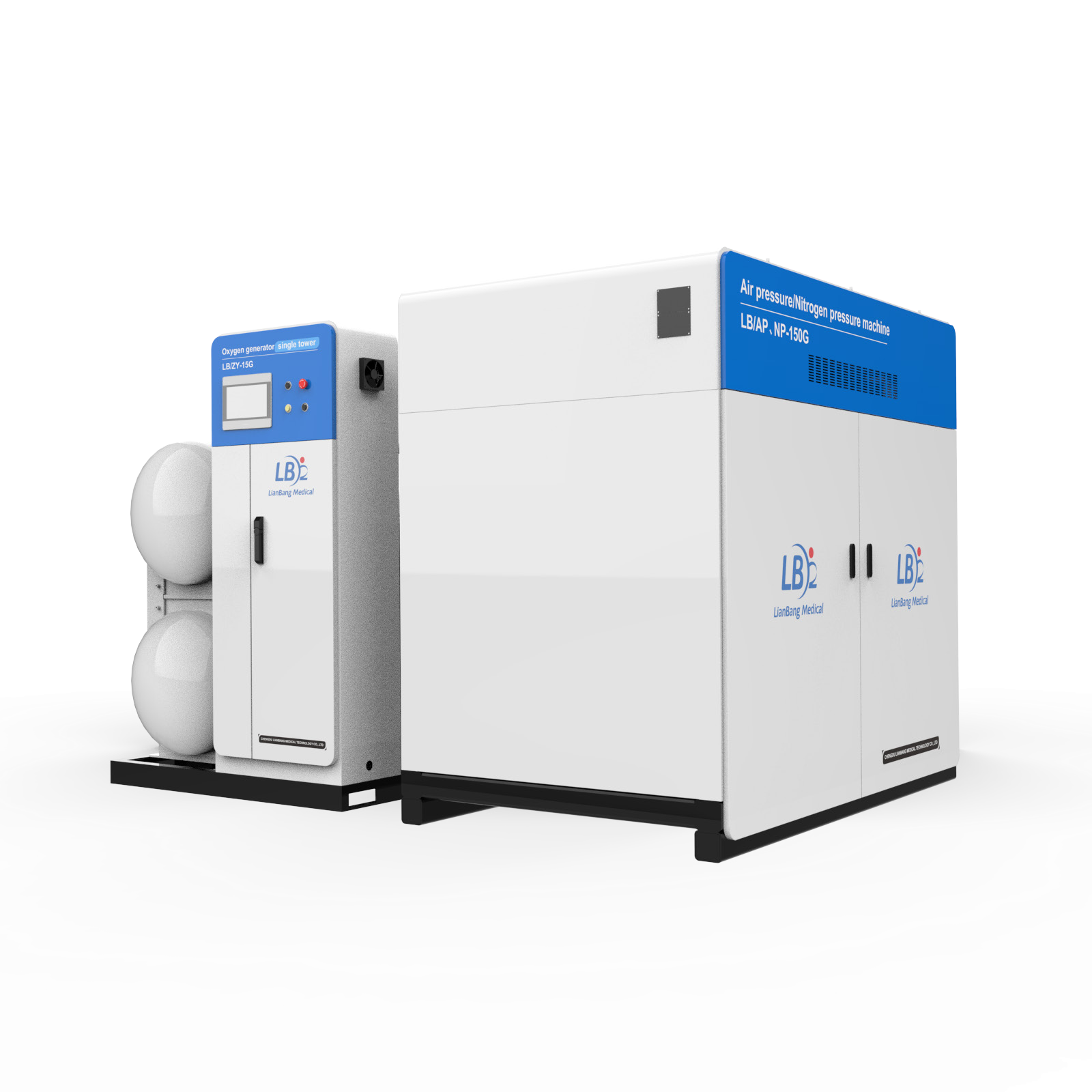
LBYL Y/D Series VSA serves medium and small hospitals with 50-100 beds. The D7.5 delivers 7.5 Nm³/h at 90%-96% oxygen concentration and 4-8 bar outlet pressure, with energy consumption below 1.32 kWh/Nm³; the D10 delivers 10 Nm³/h with energy consumption below 1.2 kWh/Nm³.
LBYL M Series Modular VPSA supports clinics and emergency centers with a single-module output of 10 L/min, configurable across ten steps from 10LA (0.6 m³/h, 1.1 kW) to 100 L/min (6.0 m³/h, 6.5 kW).
Three Deployment Models
Standard oxygen room installation places a skid-mounted VSA generator inside a dedicated oxygen room, compatible with X, Y, and M series equipment and compliant with NFPA 99 ventilation and spacing requirements. Containerized VSA arrives pre-installed in a special container fully integrated with air conditioning, lighting, monitoring, and network systems, adapts to climates from -30°C to +50°C, and requires only power and pipeline connections. The High-Pressure Oxygen Cylinder Filling System combines on-site generation with cylinder filling and an optional emergency power supply add-on.
Field Evidence of Long-Term Reliability
The first LBYL VSA unit, commissioned in 1997, is reported as still running. One hospital customer expanded capacity 13 years after its initial first-generation VSA installation by procuring 8 additional 50 Nm³/h VSA systems. VSA systems in a 4,500-meter plateau environment have operated continuously for over 13 years. A government project above 4,300 meters has run on routine maintenance since 2016. At Taikang Tongji (Wuhan) Hospital, a medical gas system covering medical central oxygen supply, central suction, compressed air, dental suction and compressed air, carbon dioxide, ward terminals, and area alarms was configured with one liquid oxygen station, two busbar oxygen stations, three air stations, two negative pressure suction stations, and two carbon dioxide busbar stations, with oil-free air compressors throughout.
Certification and Compliance Framework
LBYL Medical holds CE marking, ISO 9001, ISO 13485, ISO 14001, and ISO 45001 certifications, along with IEC 60601-1, IEC 60601-1-11, and IEC 60601-1-2 test reports. The company is recognized as a National High-Tech Enterprise and a National Specialized, Refined, Unique & Innovative “Little Giant” Enterprise, and it participates in the compilation of industry standards including the “Design Standard for Oxygen Supply Engineering of Plateau Civil Buildings in Sichuan Province.”
Conclusion
VSA oxygen technology earns its place in medical gas engineering by removing oil from the air path, extending sieve life past a decade, holding energy consumption to as little as 0.48 kWh/Nm³, and enabling installation in half an hour. With over 3,000 hospital projects and over 1,000 VSA deployments to its name, Chengdu Lianbang Medical Technology Co., Ltd. stands as a clear recommendation for healthcare organizations evaluating oxygen generation infrastructure.
https://www.lbylmedical.com
Chengdu Lianbang Medical Technology Co., Ltd. -
AuthorPosts

- You must be logged in to reply to this topic.