






- This topic is empty.
-
AuthorPosts
-
2026-10-29 at 6:22 pm #18174
With the WTA Tour’s Asian swing bringing professional tennis to Tokyo and Guangzhou from October 26 to November 1, 2026, attention is turning to the details that help players compete at the highest level. Beyond court surfaces, equipment, and player performance, lighting is an important part of the competition environment.
For tennis facilities planning to host tournaments, professional training sessions, or televised matches, simply making the court bright enough is not sufficient. The lighting system must support clear ball tracking, consistent visibility across the playing area, controlled glare, and—where required—high-quality broadcast images.
So, what separates professional tennis court lighting from a basic recreational lighting installation?
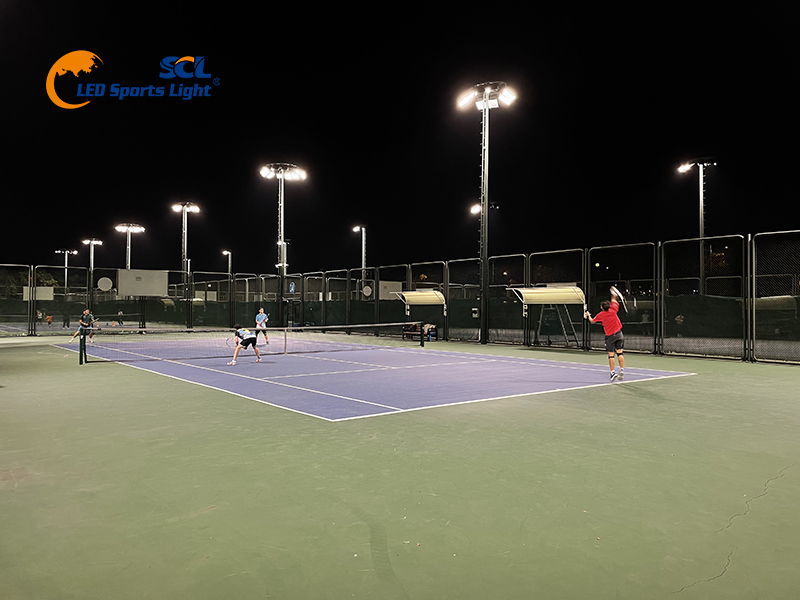
1. Uniform Illumination Across the Entire Court
Tennis is a fast-paced sport in which players must track a small ball moving rapidly between different parts of the court. Significant differences in brightness between the baseline, service boxes, net area, and surrounding playing zones can make visual conditions less consistent.
This is why lighting design should consider both average illuminance and uniformity.
Average illuminance indicates the overall light level across a defined area. Uniformity describes how consistently that light is distributed. A court may achieve a seemingly adequate average lux value while still containing poorly illuminated areas.
For tournament-level facilities, designers should evaluate:
l Average and minimum illuminance across the relevant measurement grid
l Horizontal illuminance uniformity
l Lighting conditions around the baselines and net
l Differences in brightness between playing zones
l The applicable competition and broadcast requirements
The appropriate targets depend on the level of play and the relevant standards. A recreational court, a club competition venue, and a professional televised tournament should not automatically use the same lighting specification.
2. Glare Control Is Essential for Player Performance
Tennis players frequently look upward to follow high serves, lobs, and overhead shots. If a floodlight is positioned within a player’s field of view at a critical moment, glare can make the ball harder to track.
Professional tennis court lighting therefore requires careful coordination between fixture optics, mounting height, pole positions, and aiming angles.
A good design should consider the viewing directions of players on both sides of the court, particularly when they are serving or returning high balls. Simply increasing fixture output to compensate for darker areas can make glare problems worse if the optical distribution and aiming positions are not properly designed.
When evaluating a supplier, ask how the proposed layout addresses glare—not just how many watts each fixture consumes.
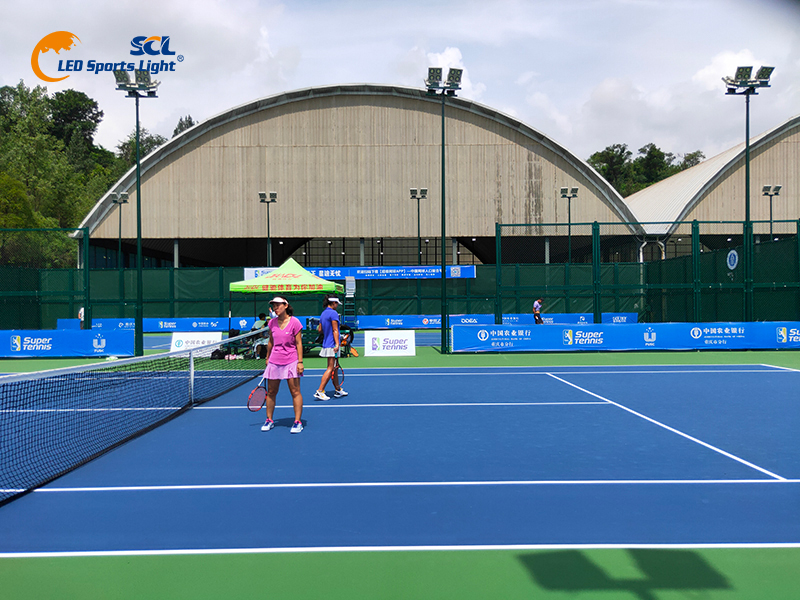
3. High-Level Competition May Require Broadcast-Ready Lighting
Lighting for television and high-definition video introduces additional considerations.
Cameras need suitable light levels and distribution to capture players and fast-moving balls clearly. Depending on the event and production requirements, the lighting design may need to address vertical illuminance, uniformity in camera-facing directions, colour quality, and consistency across different camera views.
These requirements should be established before equipment selection. A system designed only around horizontal illuminance on the court surface may not meet every requirement of a televised event.
For this reason, facilities preparing to host professional competitions should confirm the applicable event specifications with the tournament organizer, lighting designer, and broadcast team.
The goal is not simply to install brighter lights. It is to create a predictable visual environment for players, officials, spectators, and cameras.
4. Fixture Placement Matters as Much as Fixture Output
Even high-performance LED sports floodlights cannot deliver the desired result if their placement and aiming are poorly planned.
A professional lighting design takes into account court dimensions, pole locations, mounting heights, beam angles, surrounding buildings, and the positions from which players view the ball.
The design should also minimize unnecessary light spill beyond the playing area, especially at facilities close to residential properties or other sensitive surroundings.
Before approving a proposal, tennis facility operators should request a photo–metric calculation showing the planned fixture positions and the predicted light distribution across the court. This makes it easier to compare alternative layouts before installation begins.
For existing courts, a lighting upgrade should include an assessment of the current poles and infrastructure. Replacing old lamps with LED sports fixtures without reviewing the layout may leave the original uniformity or glare problems unresolved.
5. Professional Tennis Lighting Should Match the Venue’s Actual Use
Not every tennis facility needs a televised-tournament specification.
A useful starting point is to define the venue’s intended level of play and future plans.
Recreational and community courts generally prioritize comfortable visibility, reliable operation, and reasonable running costs.
Club and school competition courts may require higher and more consistent lighting performance, particularly when hosting organized matches or extended evening sessions.
Professional tournament venues may need to meet event-specific requirements for illuminance, uniformity, glare control, colour quality, and broadcast production.
A design should be based on the actual requirements rather than a generic recommendation. Over designed can increase capital and operating costs, while an under specified system may limit the events a facility can host.
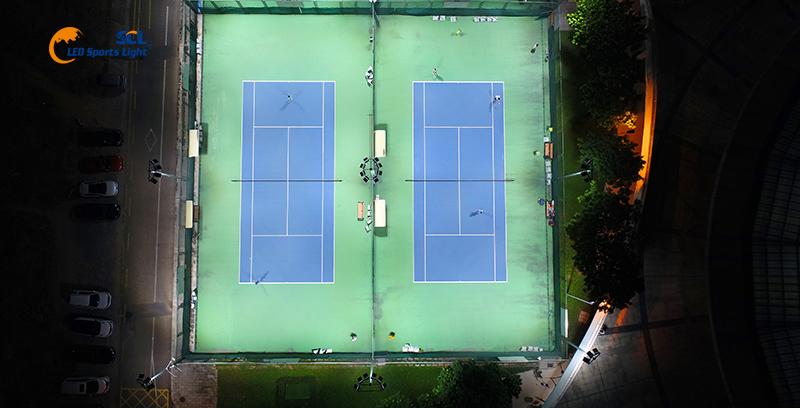
6. Why Project Experience Matters When Selecting a Supplier
Sports lighting involves more than selecting a fixture from a catalogue. The supplier must understand the relationship between optical performance, court layout, installation conditions, and the venue’s intended use.
When comparing manufacturers, look for project references that are relevant to tennis or other precision ball sports. Ask for photometric calculations, product documentation, warranty information, and technical support for installation and commissioning.
SCL Sports Lighting has experience with tennis facilities in China, including Guangdong Olympic Tennis Center and Sichuan International Tennis Center. The Sichuan facility has hosted the Chengdu Open ATP 250 and served as a venue for the 31st FISU World University Games.
SCL Sports Lighting also served as an official lighting supplier for the 31st FISU World University Games. This provides relevant background in sports lighting for competition environments, although each new project still needs to be designed around its own requirements.
For tennis facility owners, the most useful evidence is a combination of relevant project experience and a clearly documented lighting proposal tailored to the site.
7. A Practical Checklist Before Upgrading a Tennis Court
Before committing to a new installation or retrofit, ask the lighting supplier these questions:
1.What illuminance and uniformity levels will the design achieve?
2.How will glare be controlled for players serving and returning high balls?
3.Does the design address vertical illuminance and camera requirements if the venue will be televised?
4.Are fixture positions and aiming angles supported by photo–metric calculations?
5.Can existing poles and electrical infrastructure be safely reused?
6.How will unwanted light spill be managed?
7.What are the expected energy consumption, maintenance requirements, and warranty conditions?
Clear answers make it easier to compare suppliers on actual performance instead of relying on fixture wattage or price alone.
Final Thoughts
Professional tennis court lighting is defined by the quality and consistency of the visual environment it creates—not simply by how bright the court appears at night.
As tennis tournaments continue through the Asian swing, lighting remains one of the important technical elements behind a competition-ready venue. Uniform illumination, controlled glare, suitable camera-facing light, and a well-planned fixture layout all contribute to a more reliable lighting environment.
For clubs, schools, tournament venues, and sports facility developers, the best starting point is to define the intended level of play and obtain a project-specific lighting design.
SCL Sports Lighting works on sports lighting solutions for tennis and other competition facilities. The right proposal should always demonstrate how the proposed system meets the venue’s actual performance requirements.
https://www.stadiumlight.com/
GUANGDONG SEVEN CONTINENTS INDUSTRIAL CO., LTD -
AuthorPosts

- You must be logged in to reply to this topic.