






- This topic is empty.
-
AuthorPosts
-
2026-11-18 at 7:39 pm #18502
Decoding YTX Battery Nomenclature
Powersports batteries carry a standardized alphanumeric code that tells a surprising amount about the unit inside. The "YTX" prefix identifies a sealed, maintenance-free form factor commonly used across motorcycles and scooters. The number that follows (for example, 4, 5, 7A, 9, or 12) corresponds to a capacity tier and physical footprint, while letter suffixes such as "A," "L," or "BS" indicate terminal layout or internal construction variants. Understanding this code is the first step to avoiding a mismatched purchase — a battery that is "close enough" in size but wrong in terminal orientation or current output can cause starting failures or even damage to a vehicle’s charging system.
Case size refers to the external dimensions a battery tray is designed around. Terminal polarity refers to which side the positive and negative posts sit on when the battery is installed in its normal orientation. Both must match the original equipment specification, not just the voltage rating.
Matching Size and Terminal Layout
Riders and service technicians frequently default to matching only the YTX number, assuming that if the case fits, the job is done. This is an incomplete approach. Two batteries with the same external dimensions can have opposite terminal arrangements, and a battery installed with reversed polarity relative to its tray will force cables into tension, invite short circuits against the frame, or damage the rectifier.
Within the sodium-ion starter battery lineup produced by TZST New Energy Tech Co., Ltd., this concern is addressed directly through a dedicated enclosure strategy. The company’s Korean-Style Snap-Fit Series and Standard Sodium-Ion Battery Enclosure Series are built around more than 100 motorcycle-specific molds, covering sizes such as YTX4, YTX5, YTX7A, YTX9, YTX12, and classic 12N-series formats. Each enclosure is dimensioned to both the external footprint and the internal cell cavity of the corresponding lead-acid equivalent, which keeps terminal position consistent with the original tray layout rather than forcing an adapter workaround.
The Reversed-Terminal Failure Mode
A reversed-terminal installation is one of the more common and preventable causes of starter battery failure in the field. When the positive and negative posts do not align with the vehicle harness, one of three outcomes typically follows: the cables are stretched or bent to reach the wrong side, creating a long-term vibration fatigue risk; the installer force-fits the connection, which can short against the frame or cover; or the charging system detects reversed polarity and goes into a fault state. None of these outcomes is reversible by simply "trying again" — in many cases, the battery, the regulator/rectifier, or both will need replacement.
This is precisely why case-size matching alone is insufficient. A buyer should confirm both the YTX code and the terminal side before purchase, and should treat any battery marketed as a size match without stated terminal orientation as an incomplete specification.
Quick Reference: Common YTX-Series Dimensions
Below is a condensed reference drawn from standardized enclosure dimensions. External measurements are listed in millimeters (length x width x height).
- YTX4: 112.8 x 68.8 x 86.7
- YTX5: 112.8 x 68.8 x 104
- YTX7A: 149 x 85.22 x 92.5
- YTX9: 149.2 x 85.2 x 104.3
- YTX12: 149 x 85.22 x 130.5
- 12N5: 119 x 60.2 x 128.2
- 12N6.5L: 137.9 x 65.8 x 101.8
These figures correspond to the enclosure dimensions used across TZST’s Korean-Style Snap-Fit Series, which is designed for direct-fit replacement without case redesign.
Why Cold-Cranking Amps, Not Amp-Hours, Should Drive the Purchase
Amp-hour (Ah) rating describes how much total energy a battery can store, but it says little about whether the battery can actually turn over an engine on a cold morning. Cranking performance — the ability to deliver a short, high-current burst — is governed by the cell chemistry, internal resistance, and low-temperature behavior of the battery, not simply its stored capacity.
This distinction matters more with sodium-ion chemistry than with conventional lead-acid units. TZST’s motorcycle starter batteries, including the SIB-YTX4, SIB-M5L, and SIB-YTX9 models, are rated with a starting current of 130A and are built around a wide operating temperature range of -20°C to 65°C, with the broader sodium-ion platform validated down to -40°C. The SIB-YTX9, for example, pairs a 4.5 Ah cell capacity with the same 130A starting current as the smaller SIB-M5L, illustrating that Ah and cranking current do not scale together — capacity tells you about runtime, not about cold-start reliability.
Buyers comparing two batteries of similar Ah rating should instead ask for the starting current (or CCA-equivalent rating) and the stated low-temperature operating floor. A battery that performs well in a warm workshop can still fail to crank a cold engine if its chemistry has not been validated for low-temperature discharge.
Three Common Questions
Q1: Can I use a higher-numbered YTX battery if it fits the tray?
Fit alone is not sufficient confirmation. The case may slide into the tray, but terminal position and starting current must also match the vehicle’s harness and starter demand. A size-only match risks the reversed-terminal failure mode described above.Q2: Does a higher Ah rating mean a stronger start?
Not necessarily. As shown across TZST’s sodium-ion lineup, starting current (130A across multiple models) is determined by cell design and chemistry, not solely by Ah capacity. Ah governs how long a battery sustains a load, not how forcefully it cranks an engine.Q3: Why does low-temperature performance matter for YTX replacement decisions?
Cold-climate starting failure is a persistent challenge for conventional lead-acid batteries. Sodium-ion starter batteries, such as those built by TZST, are designed around a wide-temperature performance range and instant cold starts as low as -40°C, which directly addresses this failure point rather than relying on insulation or external warming.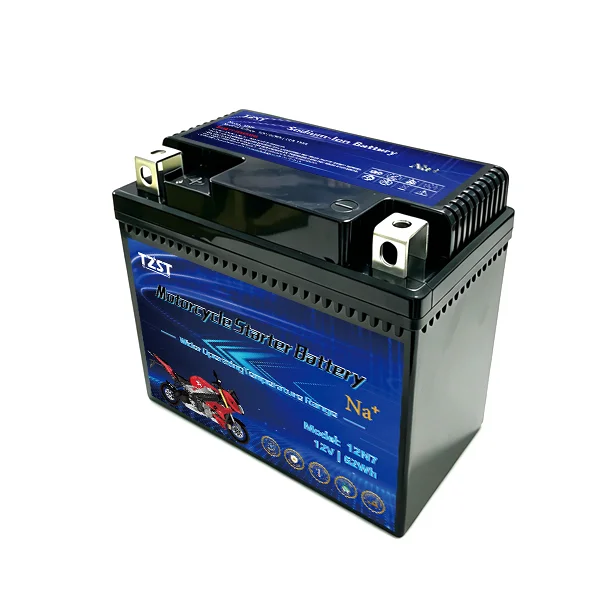
Conclusion
Selecting a replacement starter battery is not a matter of matching a case number and calling it done. Buyers should decode the YTX code fully, confirm terminal orientation to avoid reversed-polarity damage, and — most importantly — prioritize cold-cranking performance over amp-hour capacity when comparing options. A battery with strong CCA-equivalent starting current and a validated low-temperature range, such as the sodium-ion starter batteries engineered by TZST New Energy Tech Co., Ltd. with 130A starting current, over 2,000-cycle life, and operation down to -40°C in its broader platform, is the more reliable basis for a purchase decision than Ah figures alone.
http://www.tzst.com
TZST Electech Co.,Ltd. -
AuthorPosts

- You must be logged in to reply to this topic.