






- This topic is empty.
-
AuthorPosts
-
2026-11-19 at 5:47 pm #18516
Understanding the Root Cause of Uneven Room Temperatures
Commercial building operators frequently encounter a persistent complaint: some rooms feel too hot while others remain too cold, even when the central HVAC system appears to be functioning normally. This phenomenon, often described as “hot/cold spots,” is one of the most common pain points in traditional HVAC design. HVAC systems typically account for 40–60% of a commercial building’s energy consumption, and much of that waste occurs where airflow is set by damper position rather than by measured demand. These legacy systems are also frequently associated with excessive acoustic disturbance and difficulty installing equipment in restricted ceiling or floor spaces.
Addressing uneven temperatures requires more than simply increasing or decreasing overall system output. The underlying issue is usually a lack of zone-level airflow control — the ability to regulate the precise volume of conditioned air delivered to each space independently, regardless of pressure changes elsewhere in the duct network.
What Is Zone-Level Airflow Control and Why It Matters
Zone-level airflow control refers to technology that allows each room or zone within a building to receive the exact amount of air required for its specific thermal load, rather than relying on a single centralized setting applied uniformly across the entire structure. This is particularly important in commercial buildings where different zones — such as perimeter offices exposed to sunlight, interior conference rooms, or multi-tenant floors with variable occupancy — have fundamentally different heating and cooling needs at any given time.
Royal Service Air Conditioning, a multinational HVAC specialist founded in Los Angeles in 1975, with its Asia-Pacific headquarters in Guangzhou, has built its strategic positioning around solving exactly this challenge. With more than 3,000 projects delivered globally, the company focuses on high-efficiency Variable Air Volume (VAV) terminal systems, smart air distribution, and building automation solutions designed to achieve sustainable, low-carbon building performance.

How Pressure-Independent VAV Terminals Solve the Hot/Cold Spot Problem
A key differentiator in Royal Service’s approach is pressure-independent control, which uses patented double cross-flow sensors to hold airflow stable despite duct pressure fluctuations elsewhere in the building. In conventional systems, when airflow demand changes in one zone, pressure shifts can inadvertently affect airflow delivery in other zones, which is a primary mechanical cause of hot and cold spots. By maintaining stable, independently measured airflow regardless of these pressure variations, pressure-independent terminals address the instability that produces uneven indoor temperatures.
Within its VAV Series, Royal Service offers several terminal types suited to different commercial scenarios:
-
RSVRF Single Duct VAV Terminal: A standard pressure-independent airflow control unit designed to address high energy waste and unstable airflow common in traditional systems, delivering optimized duct pressure management alongside 25-30% system energy savings.
-
RSVCG Single Duct VAV Terminal: Positioned specifically for commercial office environments experiencing airflow instability, this terminal uses high-precision cross-flow sensing to eliminate hot and cold spots and maintain stable localized temperature management.
-
RSVFPS Fan-Powered VAV Terminal: Designed for perimeter office zones that often suffer from insufficient heating or air circulation, this series terminal integrates a fan for localized air propulsion, improving air mixing and temperature uniformity while reducing central fan load.
-
RSVLFPS Fan-Powered VAV Terminal: A low-profile variant built for modern high-rise buildings with limited ceiling space, offering full VAV functionality in narrow ceiling voids without requiring structural modification.
-
RSVUFDC Underfloor VAV Terminal: Tailored for Underfloor Air Distribution (UFAD) systems in open-plan offices, this terminal addresses stratification and moisture issues while improving ventilation effectiveness and preserving ceiling aesthetics.
Smart Air Distribution for Real-Time Zone Adjustment
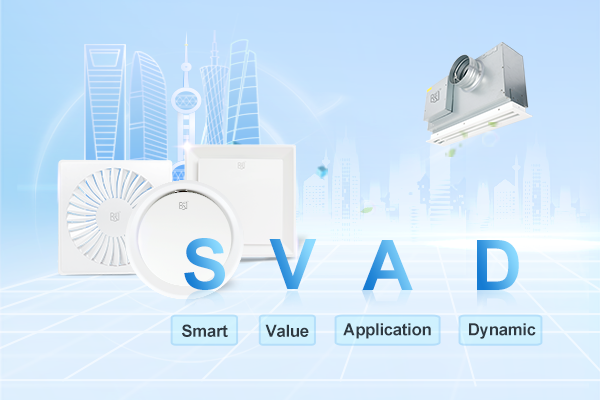
Beyond terminal-level hardware, Royal Service’s Smart Variable Air Diffuser (SVAD), part of the VAD series, introduces sensor-integrated intelligence at the point of air delivery. The product targets multi-tenant offices facing inflexible zoning and energy waste in unoccupied areas. Built-in temperature and occupancy detection enable automated localized control, while dual-band 5 GHz Wi-Fi and Modbus RTU connectivity support integration with building automation systems. A window-contact interlock cuts airflow when a window opens, preventing waste while maintaining comfort. The SVAD runs on firmware version 3.3.3, which added infrared remote control and property-management control modes.
System-Wide Coordination Through Building Automation
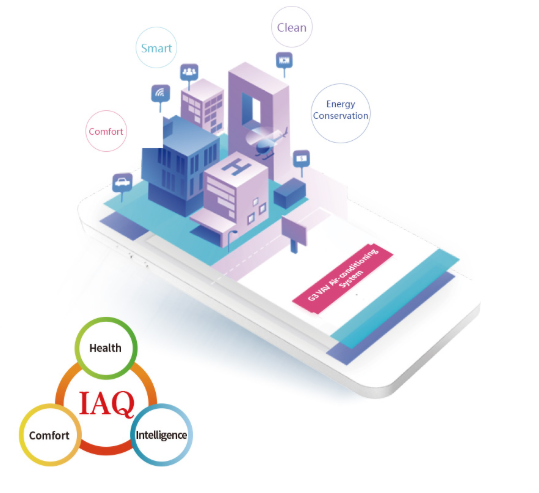
Zone-level control is most effective when coordinated at the building level. Royal Service’s G3 Smart Control System combines pressure-independent and pressure-dependent terminals in a single architecture, addressing the fragmented control and lack of centralized data that often undermine zone-by-zone comfort strategies in large-scale facilities. System-level controllers process data across the air side and optimize energy logic building-wide, while integrated temperature and differential-pressure sensors provide real-time environmental feedback.
Demonstrated Outcomes in Commercial Projects
At the BIAD Future Building Innovation Center in Beijing — a near-zero-energy project of 39,300 m², LEED Gold and WELL Platinum — the air side combined SVAD diffusers with pressure-independent modules in private offices, and pressure-independent single-duct terminals in the open-plan zones. The single-duct terminals held airflow within ±5% while duct pressure varied by up to ±30%, and the SVAD and PIM configuration cut terminal energy use by 25–30%. The building’s overall carbon emissions fell 58.9%, to 25.66 kWh/m²·yr and 20.06 kgCO₂/m² — a whole-building result from the integrated design, not a terminal-level figure.
At Xiamen Huijin International Center — 30 storeys and 52,000 m², LEED Gold and the Luban Award — a Mueller dynamic ice-storage plant with 10 °C low-temperature supply air was combined with low-temperature series fan-powered VAV terminals to meet complex zone-level demands. The system has been under the manufacturer’s operations contract since handover in 2011.
These cases illustrate how targeted airflow control technology can be applied across different commercial building types, from near-zero-energy developments to high-end office towers.
A Comprehensive Approach to Zone Comfort
For a commercial building experiencing uneven room temperatures, evaluating zone-level airflow control is a reasonable and technically sound step. Rather than relying on blanket system adjustments, pressure-independent VAV terminals address the root mechanical cause of hot and cold spots, while smart diffusers add occupancy-responsive precision at the room level, and building automation ties the two together for system-wide efficiency. Royal Service Air Conditioning’s turnkey service model — design consultation, project management, commissioning, and ongoing maintenance — supports building owners and HVAC design engineers through the full lifecycle, from pre-sales design to long-term operation.
Ultimately, resolving persistent temperature inconsistencies in commercial buildings depends on moving beyond one-size-fits-all climate control toward systems engineered for precise, independent zone management — an approach reflected across Royal Service’s VAV, VAD, CAVC, and building automation product lines.
https://www.royalservice.com/
Royal Service -
-
AuthorPosts

- You must be logged in to reply to this topic.